
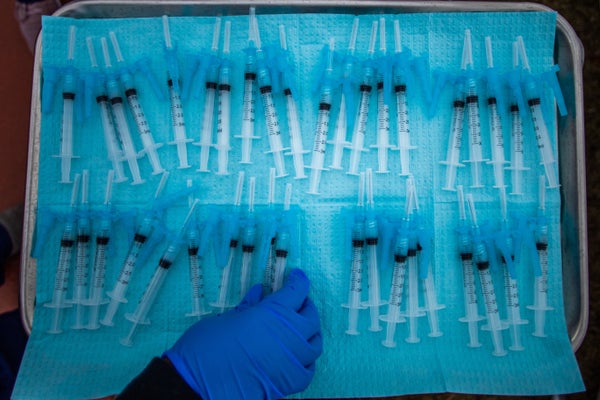
The U.S. Centers for Disease Control and Prevention has recommended an updated COVID vaccine for everyone aged six months and older, following the advice of an advisory panel that met on Tuesday. On Monday the Food and Drug Administration approved a single dose of the updated Pfizer-BioNTech and Moderna vaccines for people aged 12 years and older and issued an emergency use authorization for their use in children six months through 11 years old. The vaccines could be available within a week.
“We have more tools than ever to prevent the worst outcomes from COVID-19,” said the CDC’s director Mandy Cohen in a statement on Tuesday. “CDC is now recommending updated COVID-19 vaccination for everyone 6 months and older to better protect you and your loved ones.”
The CDC’s Advisory Committee on Immunization Practices voted 13 to 1 in favor of recommending the vaccines for all age groups. The one person who voted against doing so, Pablo Sanchez, a professor of pediatrics at the Ohio State University College of Medicine, cited insufficient evidence of the vaccines’ safety in children. But he added that he was not against the vaccines themselves. The general consensus was that the new vaccines are safe and effective for all age groups studied and that they will provide important protection against severe disease as the Northern Hemisphere heads into another winter respiratory virus season.
On supporting science journalism
If you're enjoying this article, consider supporting our award-winning journalism by subscribing. By purchasing a subscription you are helping to ensure the future of impactful stories about the discoveries and ideas shaping our world today.
In the past week there has been some debate among experts over which age groups should be offered the vaccine. People aged 65 and older, pregnant people and those with underlying medical conditions are at the greatest risk of severe disease from COVID, so some experts have argued that the U.S. should prioritize vaccinating people in those categories (an approach the U.K. has taken) instead of vaccinating everyone, including young, healthy people. But others have noted that all age groups experience some risk of severe disease and death from COVID. And some evidence suggests vaccination may reduce the risk of long COVID. Ultimately, most of the advisory panel members felt that the benefits of offering the vaccine to all people aged six months and older outweighed the risks.
Those risks include the very slight possibility of heart inflammation, known as myocarditis or pericarditis—which has been observed in a very small number of people, mainly adolescent boys and young men, who received the Pfizer or Moderna COVID vaccine. Most of these cases resolved on their own without treatment, and the benefits of vaccination still outweighed the risks, according to the advisory panel’s analysis.
Unlike last year’s bivalent vaccine, the updated vaccines target only a single strain of the COVID-causing virus SARS-CoV-2: the Omicron XBB.1.5 variant, which was the dominant one for much of this year. Experts believe this formulation will also help protect against newer variants, including a rare type called BA.2.86, which has more than 35 distinct mutations in its spike protein, compared with XBB.1.5.
An updated version of a protein-based vaccine manufactured by Novavax has not yet been approved by the FDA for the fall booster season. If approved, that vaccine could offer an alternative to the existing mRNA vaccines.
The COVID vaccines join vaccines for two other seasonal viruses that send many people to the hospital: influenza and respiratory syncytial virus (RSV). Those vaccines are already available at pharmacies.