
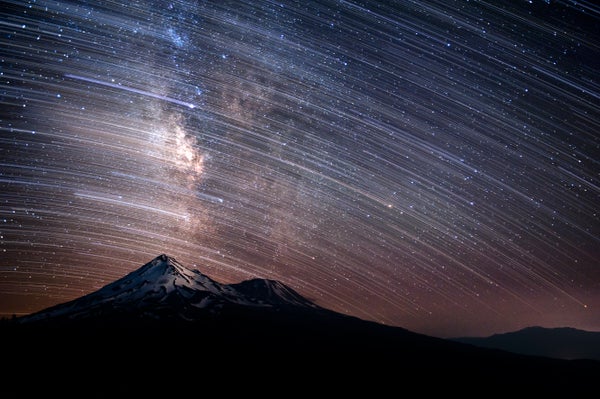
The sky is always changing. The planets move overhead as they trace their paths around the sun, and the moon rotates through the heavens as it circles our own world. Though the stars that provide their backdrop stay fixed in relation to one another, they too spin above as Earth makes its daily revolution and its yearly passage around the sun. To appreciate this ever-changing view, grab these sky maps, go outside at night, and look up!
October—November 2018: Visibility of Planets
Two of the brightest planets can be seen in the evening sky: Saturn and Mars. Jupiter’s visibility is coming to an end as the planet moves closer to the wun. Venus switches from the evening to the morning sky, where it appears as a bright object in November.
On supporting science journalism
If you're enjoying this article, consider supporting our award-winning journalism by subscribing. By purchasing a subscription you are helping to ensure the future of impactful stories about the discoveries and ideas shaping our world today.
October | Event |
|---|---|
2 | Moon: last quarter Moon reaches northernmost declination (+20.7° |
5 | Venus stationary Moon at perigee (366,392 km), apparent diameter 32´ 36 |
9 | New moon |
11 | Evening sky: moon near Jupiter |
14 | Evening sky: moon near Saturn |
15 | Moon reaches southernmost declination (–22.0°) |
16 | Moon: first quarter |
17 | Moon at apogee (404,227 km), apparent diameter 29´ 35 Evening Sky: moon near Mars |
22 | Morning sky: maximum of Orionid meteor shower |
24 | Uranus in opposition Moon: full moon |
26 | Venus in inferior conjunction |
31 | Moon: last quarter Moon at perigee (370,204 km), apparent diameter 32´ 16 |
Venus is in inferior conjunction on October 26. The planet reappears in the morning sky in east-southeast direction around November 3, about 30 minutes before sunrise. Its morning visibility then strongly improves, and you might notice the daily motion of Venus relative to the star Spica, the brightest star in the constellation Virgo. Again, binoculars are recommended, because Spica is five magnitudes fainter than Venus.

Mars is moving eastward through the constellation Capricornus and enters Aquarius on November 11. The red planet becomes visible at dusk, when it is well above the southern horizon. Its brightness gradually decreases during October and November. The waxing moon is near Mars in the evening sky on October 17 and November 15.
Saturn is about halfway between Jupiter and Mars in the evening sky in the constellation Sagittarius, close to the Milky Way’s center. If you want to observe Saturn’s famous rings in a telescope now is the time—for the remainder of the year Saturn will move too close to the sun for observation.
November | Event |
|---|---|
2 | Morning sky: moon near Regulus |
6 | Mercury greatest elongation east (23°) |
7 | Moon: new moon |
11 | Evening sky: moon near Saturn |
12 | Occultation of dwarf planet Pluto by the moon Moon reaches southernmost declination (–22.2°) |
14 | Venus stationary Moon at apogee (404,339 km), apparent diameter 29´ 32 |
15 | Moon: first quarter Evening sky: moon near Mars |
17 | Mercury stationary Minor planet Juno at opposition |
18 | Maximum of Leonid meteor shower |
23 | Moon: full moon |
25 | Neptune stationary |
26 | Jupiter in conjunction with sun Moon reaches northernmost declination (+21.1°) Moon at perigee (366,620 km), apparent diameter 32´ 35 |
27 | Mercury in inferior conjunction |
29 | Morning sky: moon near Regulus |
30 | Moon: last quarter |
Mercury remains hidden in the sun’s bright glare during October. The innermost planet achieves its greatest eastern elongation on November 6. Around this date, Mercury might be spotted in the southwest direction with the help of binoculars about 40 minutes after sunset, when the evening sky is still bright. The planet is only 3° above the horizon at this time and it will set 20 minutes later. But make sure not to confuse Mercury with the somewhat brighter Jupiter, which is nearly at the same altitude, but 8° further to the west. The best chance to see Mercury is on the evening of November 9, about 45 minutes after sunset: in the southwest sky Mercury is 9° vertically beneath the 2.3-day-old waxing moon. On November 27, Mercury is in inferior conjunction, between the Earth and the sun.
Jupiter can only be seen in the evening sky, close to the horizon after suset. From early November it becomes too close to the sun for observation. The gas planet is in conjunction with the sun on November 26.
