
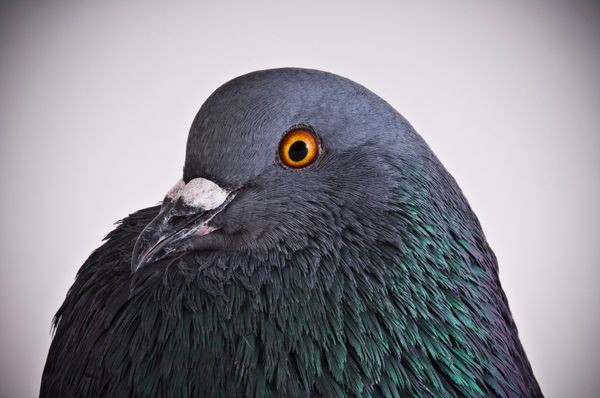
Strutting and fluttering around their urban homes, pigeons have adapted to an ever-shifting environment. Their surroundings aren’t the only things that are constantly changing: New research suggests the birds themselves avoid stability in their decision-making, instead choosing to live “at the edge of chaos.” As model species for learning and behavior, these birds are helping researchers test a century-old law about how humans and other creatures take in information.
When learning something new, people and animals alike tend to repeat behaviors that are rewarded. This principle, which was first proposed by Edward Thorndike in 1898, is so well established in psychology that it’s become known as the law of effect. But the law implies that beyond making a behavior more frequent, rewards also make it more consistent, reducing variability in the specific way behaviors are performed over time.
Although scientists have repeatedly tested whether rewards increase the frequency of behaviors, their effect on the consistency of these behaviors is less well studied. University of Iowa experimental psychologist Edward A. Wasserman and his colleagues decided to put it to the test in pigeons—a species that has been integral to the study of learning at the university’s Comparative Cognition Laboratory for more than 50 years. And the study’s results, published in the Journal of Experimental Psychology: Animal Learning and Cognition, suggest these birds experience variability as the spice of life.
On supporting science journalism
If you're enjoying this article, consider supporting our award-winning journalism by subscribing. By purchasing a subscription you are helping to ensure the future of impactful stories about the discoveries and ideas shaping our world today.
To see how rewarded behaviors vary, the researchers gave pigeons a series of five colorful buttons to peck. They could peck any buttons in any order, but as long as they pecked five times, a treat would appear. Based on previous theories of learning, the scientists expected the pigeons might eventually slip into a routine—perhaps choosing to repeat patterns they know work or simply pecking the button nearest to them five times. Instead they continued pecking in a variety of patterns.
“There would be no reason not to expect that the animals would converge on a single favorite, but it never got to that point,” Wasserman says. “You could argue the birds are just utterly resistant to locking into anything stable.”
The team theorizes that pigeons’ devotion to variability might be an evolutionary advantage that aids coping with new challenges in their environment—and they expect the birds aren’t the only ones resisting uniformity. The researchers are currently conducting tests to see whether rewarded behaviors remain variable in different animals, which others in the field say might illuminate how the brain makes behavioral decisions while learning.
University of California, Los Angeles, psychology professor Aaron Blaisdell, who was not involved in the new study, is not that surprised by the results. “But this paper leaves open many questions about the [neurological] mechanisms” for future scientists to explore, he adds.