New Issue: Orbital Catastrophe Ahead? Read Now

Cheers! Ring in the New Year with Glittering ‘Champagne Cluster’ Image

A galaxy cluster discovered on New Year’s Eve in 2020 shines in a new image from NASA’s Chandra X-Ray Observatory

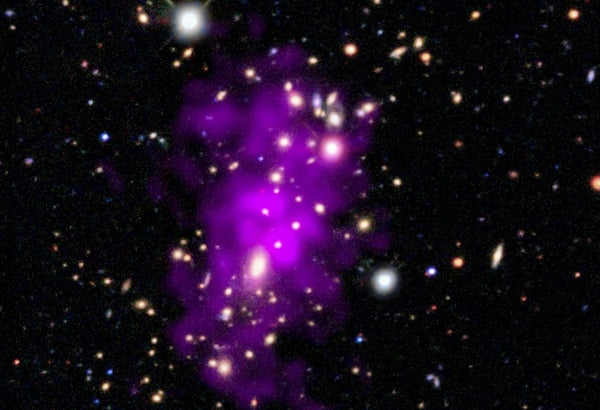
The cluster appears here as a large collection of brilliant white lights, each a distinct galaxy. A neon purple cloud stretches across the cluster’s crowded core. Many of the hundred-plus galaxies in the cluster are in two clumps of galaxies towards the top and bottom of center. Some are encircled by a faint glowing haze, while a few foreground stars gleam with diffraction spikes. Some of the smaller galaxies are tinted blue, orange, or red, and some appear more oblong than round, suggesting spiral shapes viewed edge-on. The neon purple cloud sits at the heart of the image, surrounding the most densely-packed part of the cluster. This cloud, which spreads vertically across the cluster, is multimillion-degree gas observed by Chandra. The two clumps of observable galaxies, and the spread of superheated gas, reveal that the Champagne Cluster is in fact two clusters in the process of colliding.

X-ray: NASA/CXC/UCDavis/F. Bouhrik et al.; Optical: Legacy Survey/DECaLS/BASS/MzLS; Image processing: NASA/CXC/SAO/P. Edmonds and L. Frattare

Join Our Community of Science Lovers!

Raise a toast to another orbit around the sun with a new NASA image of sparkling galaxy clusters fittingly dubbed the “Champagne Cluster.”

The object was first discovered on December 31, 2020. But the new image combines data from NASA’s Chandra X-ray Observatory—which sees the superheated gas of the merging clusters as purple bubbles—and a collection of ground-based optical telescopes that contribute the starry background.

When the Champagne Cluster was first observed, astronomers thought the celestial object—formally named RM J130558.9+263048.4—was a single galaxy cluster, but subsequent observations have revealed that it is in fact two clusters interacting. All told, the merger involves more than 100 galaxies—plus enough multimillion-degree gas to outweigh them all.


On supporting science journalism

If you're enjoying this article, consider supporting our award-winning journalism by subscribing. By purchasing a subscription you are helping to ensure the future of impactful stories about the discoveries and ideas shaping our world today.


Scientists have two theories to explain the Champagne Cluster’s distinct appearance. Both of them were outlined in research published earlier this year in the Astrophysical Journal.

The first hypothesis is that the two clusters first collided more than two billion years ago, blowing past each other before being trapped in a gravitational dance that will eventually see them smash together again. According to the second theory, the clusters’ collision happened just 400 million years ago, and the two objects are now zipping away from each other. Either way, the researchers say, the clusters crashed into each other practically head-on.

The Champagne Cluster is a particularly interesting object for astronomers looking to understand dark matter, which is invisible to all telescopes but exerts a gravitational tug on everything around it. Scientists believe this enigmatic stuff is unlikely to interact with itself—and massive collisions between galaxy clusters such as the Champagne Cluster or a similar object dubbed the Bullet Cluster could be just the place to spot its strange behavior.

Meghan Bartels is a science journalist based in New York City. She was previously a senior reporter at Scientific American. Before that she spent more than four years as a writer and editor at Space.com, as well as nearly a year as a science reporter at Newsweek, where she focused on space and Earth science. Her writing has also appeared in Audubon, Nautilus, Astronomy and Smithsonian, among other publications. She attended Georgetown University and earned a master’s degree in journalism at New York University’s Science, Health and Environmental Reporting Program.

More by Meghan Bartels

Subscribe to Support Independent Journalism

Great science journalism requires human expertise, time, effort and creativity. And it costs money. That’s why I and the journalists here at Scientific American hope you’ll join our community.

When you subscribe, you are supporting staff and freelance journalists who are passionate about telling science stories that are true, important and compelling. Our editors and reporters are often experts in their fields, which means they understand the nuances of big discoveries and can untangle the breakthroughs from the hype. With a subscription, you are also supporting rigorous fact-checking to ensure the words we publish are precise and accurate. And you’re supporting original illustrations, graphics and photos that bring you closer to an advanced laboratory, an ice sheet in Antarctica or a space mission in orbit. You’re helping us craft other types of high-quality journalism as well: Our newsletters are carefully written, edited and curated by staffers you have or will come to know and love. Our Science Quickly podcast is based on original reporting, collaboration with editors and scientists and exacting production.

Subscriptions keep this engine running so we can continue to deliver thoughtful, rigorous and independent science journalism to you. In an era of viral misinformation, this work is crucial. If you value what we do, I hope you’ll consider joining us as a subscriber

Thank you,

Jeanna Bryner, Editor in Chief, Scientific American

Subscribe