
DNA recovered from two naturally mummified Indigenous people in northern Chile has yielded the first known ancient smallpox genomes in the Americas. The nearly identical genomes suggest that the two people, who lived sometime between 1492 and 1631, were infected during the same outbreak or by the same strain that was circulating through the region at the time.
Reported in Science Advances, the discovery rare molecular evidence of European colonization’s role in spreading smallpox to Indigenous populations—to devastating effect. The newly identified viral lineage also fills a gap in the virus’s evolutionary history, supporting long-held historical accounts that European colonization introduced smallpox to the Americas.
The researchers found it by accident. “The original project wasn’t trying to find pathogens,” says study co-author Constanza de la Fuente Castro, an anthropologist at the University of Chile. Instead she and her colleagues had sampled the remains to study the ancestry and population history of people who lived in northern Chile.
On supporting science journalism
If you're enjoying this article, consider supporting our award-winning journalism by subscribing. By purchasing a subscription you are helping to ensure the future of impactful stories about the discoveries and ideas shaping our world today.
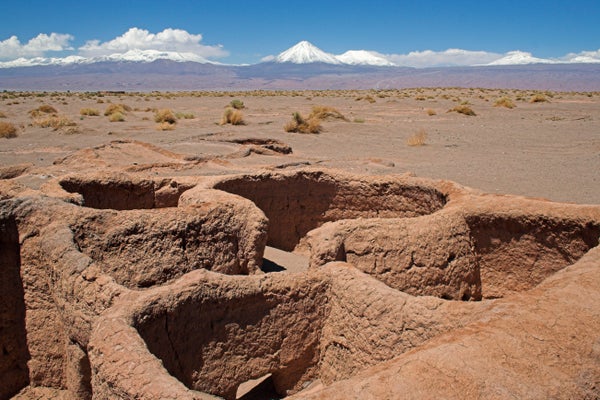
That changed when Bruno Romero González, a doctoral student at Trinity College Dublin and the study’s lead author, proposed screening the samples for traces of ancient infectious diseases. Using software that scans DNA for the genetic signatures of ancient bacteria and viruses, the team analyzed samples from people buried at the Camarones 9 archaeological site. Samples from an adult woman and a young man yielded fragments of variola virus, the pathogen that causes smallpox.
“While two genomes might not sound like a lot, it’s a significant step in the total number of historical variola virus genomes available,” says Ana Duggan, acting chief of computational and operational genomics at the Public Health Agency of Canada’s National Microbiology Laboratory, who was not involved in the study.
The discovery sharpens that broad history by anchoring a smallpox strain in northern Chile. Colonial chroniclers recorded epidemics, but their descriptions cannot always identify the responsible pathogen or follow its spread through Indigenous communities.
“Historical records can broadly capture what happened in the past, but they’re not necessarily super accurate on the local level,” says study co-author Shigeki Nakagome, a geneticist at Trinity College Dublin.
That is especially true in Chile, where written accounts of smallpox begin much later.
“We didn’t know that there was evidence of smallpox here,” says de la Fuente Castro. “We don’t even have a historical record of that.”
The genomes also add a previously unknown branch to smallpox’s evolutionary tree. The now extinct lineage branched off after medieval European strains but before those that gave rise to modern smallpox.
The genomes preserve an intermediate stage in the virus’s specialization for humans. As variola adapted to its only known host, mutations disabled some genes that had become unnecessary. By comparing the Chilean genomes with ancient and modern strains, the researchers traced how that pattern developed.
The virus appears to have accumulated mutations at a relatively steady pace for centuries before entering an approximately 200-year period during which its genome changed much more slowly. That lull coincided with the height of European colonial expansion, when increasingly connected populations and repeated epidemics may have favored a virus that was already well adapted to humans.
Its evolutionary pace picked up again around the start of widespread vaccination.
“We cannot say that there is a proper causation,” Romero González says. “But it is suspicious, at the very least.”
Romero González’s suggestion to screen for pathogens (and de la Fuente Castro’s willingness to share her data) turned a population-history project into the first genomic evidence of a smallpox strain circulating in colonial Chile.
“It was kind of like a perfect collaboration for us,” says de la Fuente Castro. “We were basically working with a research team that has more experience than us in pathogens, whereas we have more experience in the human side of things.”