New Issue: Orbital Catastrophe Ahead? Read Now

China is reportedly testing a new airborne wind turbine

This gravity-defying machine appears to work much like a ground-based wind turbine—but in the air

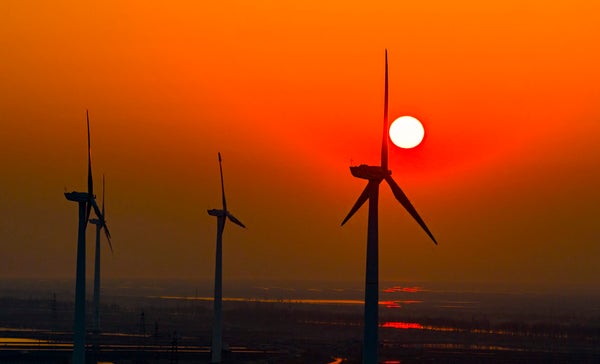
Wind turbines rotates against the wind in a vast coastal mudflat in China

Wind turbines in the city of Yancheng in the Chinese province of Jiangsu.

CFOTO/Future Publishing via Getty Images

Join Our Community of Science Lovers!

The future of renewable energy might be in the sky. Researchers in China have reportedly tested a new, gravity-defying wind turbine system that they say could generate power from the airspace above cities.

The turbine is called the S2000 Stratosphere Airborne Wind Energy System, or SAWES. Held up by what is essentially a helium blimp, the machine reportedly generated 385 kilowatts of electricity from 2,000 meters (more than 6,500 feet) above the city of Yibin in China’s province of Sichuan, according to a recent Euronews report.

You can see it in action in the video below.


On supporting science journalism

If you're enjoying this article, consider supporting our award-winning journalism by subscribing. By purchasing a subscription you are helping to ensure the future of impactful stories about the discoveries and ideas shaping our world today.


"Traditional wind turbines operate by rotating their blades when wind strikes them, thereby generating electricity,” said Weng Hanke, co-founder and chief technology officer of the turbine’s maker, Beijing Linyi Yunchuan Energy Technology, to Euronews. “This generator functions similarly, except that power generation occurs not at ground level but in the air.” As the blades spin, cables carry electricity to the ground.

Researchers reportedly conducted similar tests last September, and the machine is still a prototype. Although China is the world’s largest emitter of carbon dioxide, the country is also the global leader in renewable energy, especially wind and solar.

Jackie Flynn Mogensen is a breaking news reporter at Scientific American. Before joining SciAm, she was a science reporter at Mother Jones, where she received a National Academies Eric and Wendy Schmidt Award for Excellence in Science Communications in 2024. Mogensen holds a master’s degree in environmental communication and a bachelor’s degree in earth sciences from Stanford University. She is based in New York City.

More by Jackie Flynn Mogensen

Subscribe to Support Independent Journalism

Great science journalism requires human expertise, time, effort and creativity. And it costs money. That’s why I and the journalists here at Scientific American hope you’ll join our community.

When you subscribe, you are supporting staff and freelance journalists who are passionate about telling science stories that are true, important and compelling. Our editors and reporters are often experts in their fields, which means they understand the nuances of big discoveries and can untangle the breakthroughs from the hype. With a subscription, you are also supporting rigorous fact-checking to ensure the words we publish are precise and accurate. And you’re supporting original illustrations, graphics and photos that bring you closer to an advanced laboratory, an ice sheet in Antarctica or a space mission in orbit. You’re helping us craft other types of high-quality journalism as well: Our newsletters are carefully written, edited and curated by staffers you have or will come to know and love. Our Science Quickly podcast is based on original reporting, collaboration with editors and scientists and exacting production.

Subscriptions keep this engine running so we can continue to deliver thoughtful, rigorous and independent science journalism to you. In an era of viral misinformation, this work is crucial. If you value what we do, I hope you’ll consider joining us as a subscriber

Thank you,

Jeanna Bryner, Editor in Chief, Scientific American

Subscribe