
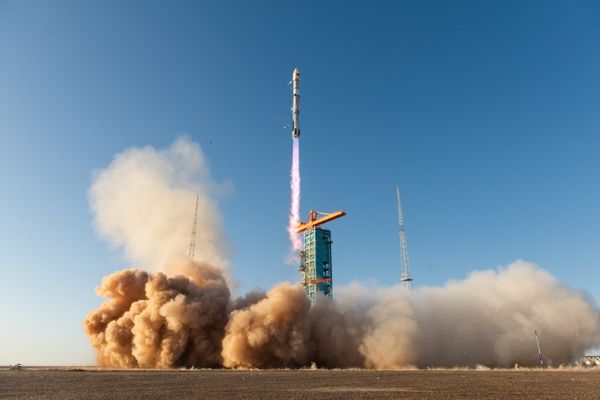
Chinese space start-up LandSpace successfully landed and recovered the first stage of its Zhuque-3 rocket on Wednesday. The feat puts the firm in league with U.S. space companies Blue Origin and SpaceX—and it shows how close China is to the U.S. in the new space race.
The success comes eight months after LandSpace’s first attempt to recover the Zhuque-3 booster ended in flames, with the vehicle plummeting back to Earth and exploding on the pad. And it has been just a month since China’s Long March 10B—a vehicle made by the China Academy of Launch Vehicle Technology, an affiliate of the state-owned China Aerospace Science and Technology Corporation (CASC)—also managed to successfully land its first stage after an orbital test.
On August 19 the rocket launched from the Dongfeng Commercial Space Innovation Pilot Zone in northwestern China at around 7:35 A.M. local time and entered orbit a short time later. The booster returned to the company’s landing site, some 242 miles from the launchpad, in the Chinese province of Gansu.
On supporting science journalism
If you're enjoying this article, consider supporting our award-winning journalism by subscribing. By purchasing a subscription you are helping to ensure the future of impactful stories about the discoveries and ideas shaping our world today.
Zhuque-3 is designed to be China’s answer to SpaceX’s Falcon 9: a workhorse of a reusable rocket that can reliably loft satellites and other spacecraft into orbit again and again. But there are some key differences which show how far the Chinese rocket still has to go to truly rival SpaceX.
At 66.1 meters (216 feet) in height, Zhuque-3 is made of stainless steel, which, LandSpace claims, makes the rocket cheaper to build compared with the 70-meter-high (about 230-foot-high) Falcon 9. That material also makes the Zhuque-3 more durable on reentry to Earth’s atmosphere than the SpaceX rocket’s aluminum alloy shell, according to LandSpace. But the Zhuque-3 can’t carry as much load as the Falcon 9: the Chinese rocket can lift just 14.2 metric tons to low-Earth orbit compared with the 22.8 tons that the Falcon 9 can loft into space. It is also designed to be reused as many as 20 times—fewer than the most reused Falcon 9 booster, which completed 36 flights and landings as of July 9.
Still, the launch and recovery are a milestone in the race between China and the U.S. to dominate Earth’s orbit—and eventually the moon. The U.S. plans to put humans back on the moon as soon as 2028, but contingencies such as whether the planned landing vehicle will be ready on time could delay that timeline. China, meanwhile, plans to land humans on the moon by 2030. Already, Beijing has shown its crewed lunar lander, called Lanyue, can successfully land and take off again in simulated conditions. The country plans to use two Long March 10B rockets for its first human landing mission: one will carry a crew capsule, and the other will carry the lunar lander. In the coming year or so, there will likely be flights that will test whether these spacecraft can safely rendezvous in orbit, as well as uncrewed test missions to the moon.
Whichever country wins the race to put humans back on the moon this century, it will give them the advantage for setting up more permanent lunar bases and crewed outposts. Speaking to Scientific American earlier this year, Victoria Samson, chief director for space security and stability at the Secure World Foundation, predicted that the race could be more of a tie. “I do see the United States getting there first but just barely, and I think that the Chinese have a better chance of getting a permanently crewed station on the moon first,” she said.