
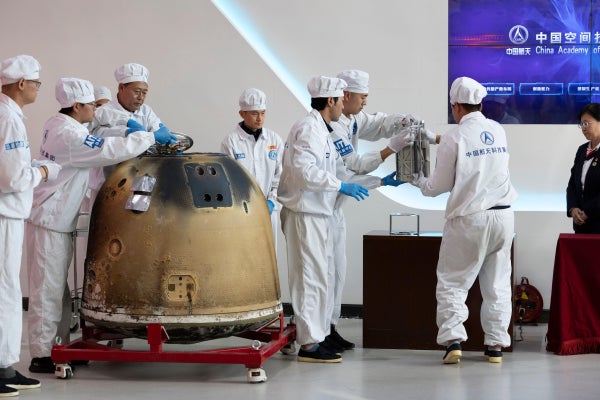
Sifting through the first-ever rock samples collected from the far side of the Moon, scientists in China have unearthed a surprise: fragments of a rare type of meteorite that could help to piece together the Solar System’s history. The debris — scooped up by China’s Chang’e-6 mission and returned to Earth in June last year — resembles material from asteroids that carry dust pre-dating the Solar System. Studying the chemical composition of this debris could help to trace how asteroids seeded planetary bodies such as Earth and the Moon with volatile compounds, including water.
“The Chang’e-6 mission has a list of major questions to answer, but this wasn’t even on that list,” says Yuqi Qian, an Earth and planetary scientist at the University of Hong Kong, who was not involved in analysing the fragments. “It’s such an unexpected and important finding.”
The authors reported their discovery earlier this week in the Proceedings of the National Academy of Sciences.
On supporting science journalism
If you're enjoying this article, consider supporting our award-winning journalism by subscribing. By purchasing a subscription you are helping to ensure the future of impactful stories about the discoveries and ideas shaping our world today.

Olivine-bearing meteorite fragment collected by the Chang'e-6 mission from the lunar farside.
Yi-Gang Xu
Near and far
Most missions that have returned rocks from the Moon have sampled the surface facing Earth — the near side — which has fewer craters and has hosted greater volcanic activity. Chang’e-6, however, landed on the far side, at the Moon’s largest, deepest crater — the South Pole–Aitken Basin, which accounts for about one-quarter of the Moon’s surface area. One of the main objectives was to better understand why the far side looks so different from the near side.
Another was to explore the huge basin, which scientists think was created when an asteroid smashed into the Moon about four billion years ago. The crater is probably rich with fragments from that and other asteroid impacts, alongside rock from the lunar mantle — the layer beneath the crust — dredged up by the collisions.
But the discovery of the rare meteorite fragments was a surprise. At first, the researchers thought the samples came from the Moon’s mantle. But after analysing the iron, manganese and zinc levels in the debris, they found a mismatch with other lunar materials, indicating they were not from the Moon itself. So, the team examined the relative levels of three oxygen isotopes in the samples; these ratios are “like human fingerprints” and can tell you what type of planetary body the debris comes from, says Mang Lin, an author of the paper and geochemist at the Chinese Academy of Sciences’s Guangzhou Institute of Geochemistry (GIG). “This approach is basically space forensics.”
The isotope signature closely matched that of two rocky asteroids already studied by humans, named Ryugu and Bennu. NASA grabbed samples from Bennu in 2020, and the Japanese space agency collected fragments of Ryugu in 2019. Both asteroids held dust grains pre-dating the Solar System, as well as elusive volatile compounds such as water.
Analysis of the new fragments seems to confirm that this type of asteroid delivered a significant supply of water and other compounds to the Moon. By further studying the chemical composition of the samples, scientists might be able to zero in on what part such space rocks played in the development of Earth and the Moon. The finding is especially exciting because this type of meteorite rarely survives when it hits Earth, so samples are rare, says co-author Jintuan Wang, a geosciences researcher also at GIG. “These materials are extremely fragile and tend to break apart when they enter Earth’s atmosphere.”
Team leader Yi-Gang Xu, also at GIG, thinks that by studying more Chang’e-6 samples, the group might pinpoint the age of such meteorite fragments, which would help to determine whether their parent asteroid created the South Pole–Aitken Basin.
This article is reproduced with permission and was first published on October 22, 2025.