
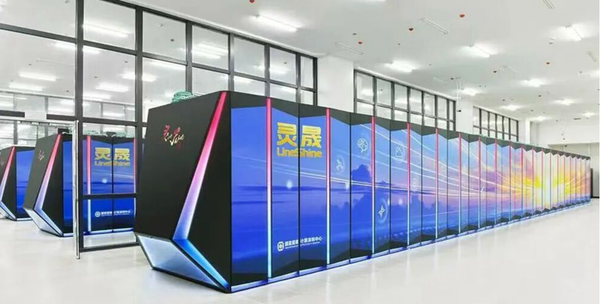
A Chinese supercomputer has topped global rankings for speed for the first time.
The machine, called LineShine, placed first in the TOP500, a twice-yearly ranking of the world’s fastest supercomputers. Built by the Shenzhen Cloud Computing Center, it is located at the National Supercomputing Center in Shenzen. It consists of 13.79 million computing cores built into 304-core LX2 processors.
LineShine’s ranking pushes the previous winner, Lawrence Livermore National Laboratory’s El Capitan, which is housed in California, down to second place.
On supporting science journalism
If you're enjoying this article, consider supporting our award-winning journalism by subscribing. By purchasing a subscription you are helping to ensure the future of impactful stories about the discoveries and ideas shaping our world today.
Originally conceived as part of a supercomputer meeting in Mannheim, Germany, in 1993, the TOP500 list has been released twice per year since then and has generally been dominated by U.S. supercomputers. With contributions by computer scientists, supercomputer manufacturers and the public, the rankings are based on how well the machines fare in running a software package called the High-Performance Linpack (HPL), which involves conducting as many calculations within a series of complex algorithms as possible in a single second. This metric, expressed in exaflops, is the measure of how powerful the supercomputer is. A single exaflop is the equivalent of one quintillion (or a billion billion) operations per second.
LineShine clocked in at 2.198 exaflops, but it can theoretically run even faster, with an estimated peak of 2.736 exaflops, according to the TOP500.
The Lawrence Livermore National Laboratory claims that its supercomputer, El Capitan, is capable of 2.821 exaflops, but the machine posted a mere 1.809 exaflops in this edition of the TOP500.
The top five rankings were rounded out by two other U.S. machines and another supercomputer located in Germany. Oak Ridge National Laboratory’s Frontier, in Tennessee, was measured performing 1.353 exaflops, just ahead of the Illinois-based Argonne National Laboratory’s Aurora, which posted 1.012. German research institution Jülich Supercomputing Center’s JUPITER Booster conducted an even one exaflop.
As powerful as these supercomputers are, they could one day face major competition from quantum computers. Comparing a classical machine and a quantum computer is difficult, however, because the two operate on completely different principles. Quantum computers, unlike traditional supercomputers, are not limited to binary calculations, making exaflops an irrelevant metric. And some quantum computing researchers have already claimed their machines are performing calculations billions of times faster than even the fastest supercomputers.
Editor’s Note (7/10/26): This story was updated to correct the number of calculations LineShine can perform per second.