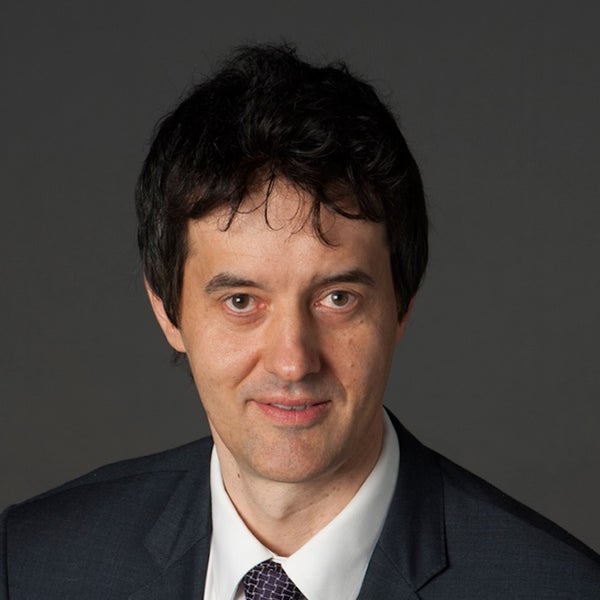
Chris Boshoff is a physician-scientist and medical oncologist serving as chief scientific officer and president of research and development at Pfizer. His work has focused on cancer biology, drug development and translational medicine in both academic and industry research settings.
[This interview was edited for length and clarity.]
How would you describe the current state of American science?
On supporting science journalism
If you're enjoying this article, consider supporting our award-winning journalism by subscribing. By purchasing a subscription you are helping to ensure the future of impactful stories about the discoveries and ideas shaping our world today.
Extraordinary—and accelerating. The convergence of biology, genomics, data science and engineering is driving a new age of discovery that would have been unimaginable even a decade ago. America’s unique ecosystem—where academia, government and industry (across biotech and tech) genuinely collaborate—remains something few countries have been able to replicate.
But we can’t be complacent. Sustaining investment in basic research and maintaining public trust in science aren’t milestones you reach; they’re daily responsibilities.
What gives me confidence is the evidence: look at what’s happening right now in oncology, cardiometabolic disease, immunology. The pace of progress is tangible, and it is accelerating. We are translating decades of foundational investment into medicines that help people live better, longer lives—and we’re just getting started.
What needs to change in American science?
We must protect and grow investment in foundational research. The breakthroughs transforming medicine today trace their roots directly to government-funded basic science, often decades earlier. Cut that foundation, and you mortgage the future. We also need to rekindle public excitement about what science makes possible. The electric response to the Artemis II moon journey reminded us of something important: People want to believe in human discovery. They want to be inspired. Scientists have a responsibility to meet that moment, to communicate not just what we do but why it matters. And we should never take for granted what makes American science exceptional: it remains the destination of choice for the world’s greatest scientific minds. That isn’t accidental: it reflects unmatched funding, a culture of bold risk-taking and a collaboration between academia, industry and government that no other nation has fully replicated.
The formula works. The task is to defend it, invest in it and never stop making the case for it.
What gives you optimism right now?
Artificial intelligence is fundamentally reshaping how we do science—not incrementally but structurally. We can now access and synthesize knowledge at a scale no human mind could manage alone, design complex molecules and vaccines with a precision that would have seemed implausible a decade ago and run more adaptive, efficient global clinical trials that bring medicines to patients faster.
This is generating a genuine reenergizing of drug discovery, a sense that the field is moving again after years of incremental progress. No serious organization wants to be left behind, and that competitive urgency is itself a catalyst for change.
Global competition, particularly from China, is adding further impetus, not just as a geopolitical pressure but as a reminder that the race to deliver better medicines and vaccines is one where humanity benefits: winning together and winning fast.
We are living through a rare inflection point: a moment when the tools available to biomedical researchers have fundamentally shifted what is possible. That is an extraordinary privilege and an extraordinary responsibility.
What’s your best advice for an early-career scientist?
Fall in love with science. Techniques and platforms will come and go, but a deep understanding of the underlying biology and genetic basis of disease will always be necessary. And make peace with failure early. The best scientists aren’t the ones who fail least—they’re the ones who extract the most from every experiment and hypothesis that doesn’t work and carry those lessons forward.
How has your field changed in the past few years?
The pace has transformed. The distance between a scientific idea [emerging] and a patient receiving a new medicine—once measured as a decade or more—is now compressing into years. We have our own examples of under five years from concept to approval. COVID made the possible undeniable: an effective vaccine and antiviral delivered in months, not years. That changed the benchmark permanently. Technology is a key driver: AI is accelerating both drug discovery and development in ways we’re only beginning to fully harness. But structure matters, too. By organizing end-to-end therapeutic areas, where discovery and clinical development sit under one roof, we’ve eliminated the handoffs and silos that delayed R&D. Speed isn’t just about tools. It’s about how you’re organized to use them.