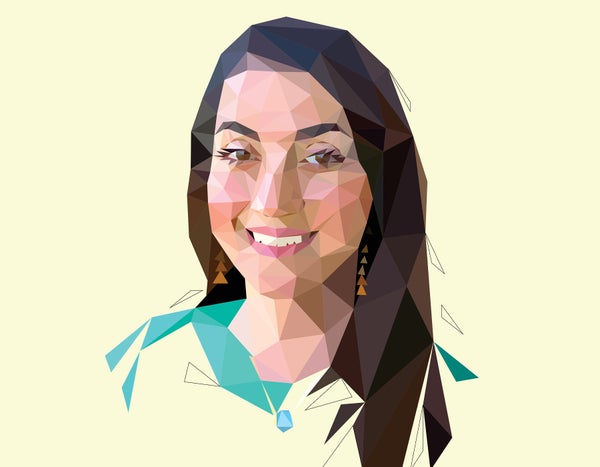
Medical researchers can spend their entire careers hunting for genetic clues to explain the cellular dysfunction behind diseases. These quests can have huge payoffs: gene therapies that target a disease’s key drivers. Christina V. Theodoris wondered whether an artificial-intelligence model could complete this task not only more quickly than previous approaches but across multiple targets and diseases. AI systems are “really accelerating the pace of discoveries,” says Theodoris, a physician-scientist at Gladstone Institutes and the University of California, San Francisco. “That’s really exciting to me.”

Christie Hemm Klok; With special thanks to the Exploratorium, San Francisco, Calif.
On supporting science journalism
If you're enjoying this article, consider supporting our award-winning journalism by subscribing. By purchasing a subscription you are helping to ensure the future of impactful stories about the discoveries and ideas shaping our world today.
Theodoris combined her expertise in AI and biological systems to develop Geneformer, a deep-learning model trained on gene-activity data from millions of cells across a range of human tissues. From those data, the model can map out the messy world of genetic regulation—when one gene gets activated, it can trigger a biochemical cascade that turns another gene on or off, which then goes on to impact another gene, and so on. She used Geneformer first to tackle progressive cardiovascular diseases such as dilated cardiomyopathy, a genetic condition that impairs the heart’s ability to pump and circulate blood. This disease could be halted or even reversed if Geneformer could identify targets for treatment. In 2023 the model hit a big milestone: it identified specific genes that, when activated or deleted (depending on the gene), could restore diseased heart cells to a healthier state.
Beyond heart disease, Theodoris is collaborating to create AI platforms for studying neurodegeneration, cancer immunology and aging. Her models, training data and code are open-source and freely available. “It’s really important to us because we want the models to be used as broadly as possible for the ultimate goal that we have, which is to impact human health.”
This article is part of “The Young American Scientists,” an editorially independent project that was produced with financial support from Regeneron. Special thanks to the Exploratorium in San Francisco, where Theodoris' portrait and video interview were captured.