
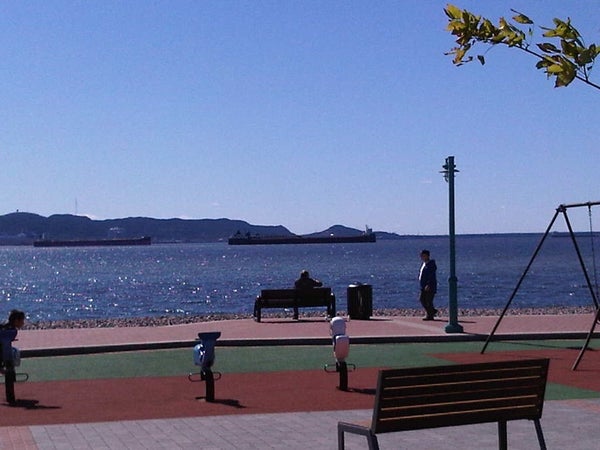
We asked Scientific American readers, as part of our special issue on cities coverage this month, to send us pictures they have taken of a science or engineering infrastructure scene outside their windows that illustrates the best or worst aspect of city life.
This offering came from Annie Lévesque, who works in the process engineering, metallurgy and mining industries. The image shows a park view of one of the numerous iron ore shipping boats that can be seen at any time in the Bay of Sept-Îles, Quebec, waiting to be filled with ore destined for the Great Lakes region. Sept-Îles is home to the largest aluminum smelter in the Americas, Aluminerie Alouette, and the gateway to the huge iron ore mines of northern Quebec and Labrador, Lévesque says.
"Two major iron ore producers, Rio Tinto IOC and Cliffs [Natural Resources, Inc.], ship their ore from installations located around the Bay of Sept-Îles," she says, "and the Port of Sept-Îles is now the second-biggest port in Canada for its volume of material shipped."
On supporting science journalism
If you're enjoying this article, consider supporting our award-winning journalism by subscribing. By purchasing a subscription you are helping to ensure the future of impactful stories about the discoveries and ideas shaping our world today.
Lévesque took this photo on September 1, 2011.
Want to join in? Please send your photograph, a description of how it illustrates the best or worst aspect of life in your city and the date it was taken to submit@sciam.com