
Major dengue outbreaks in the Americas tend to occur about five months after an El Niño event — the periodic warming of the Pacific Ocean that can disrupt global weather — a study has found. Meanwhile, local outbreaks tend to happen about three months after summer temperatures peak and roughly one month after peak rainfall.
The study, published today in Science Translational Medicine, paints a clearer picture of the relationship between the mosquito-borne disease and climatic conditions in the Americas, a region that saw a record-breaking 13 million cases in 2024.
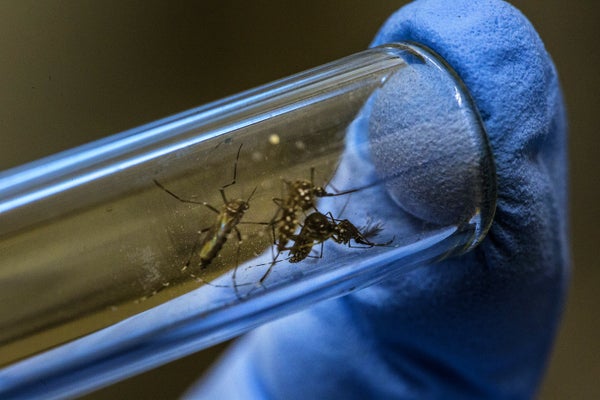
Dengue is caused by four closely related viruses and spread by the Aedes species mosquitoes. There is no specific treatment, and the disease can lead to fever, bone pain and even death.
On supporting science journalism
If you're enjoying this article, consider supporting our award-winning journalism by subscribing. By purchasing a subscription you are helping to ensure the future of impactful stories about the discoveries and ideas shaping our world today.
The research relied on roughly three decades of surveillance data from 14 countries. Cases in the region tended to rise and fall in sync, on average six months apart, even in places as far as 10,000 kilometres apart.
The findings are “useful to anticipate when a region might expect to see an epidemic, which can help inform planning and preparedness”, says Talia Quandelacy, a co-author and an infectious-disease epidemiologist at the University of Colorado School of Public Health in Aurora. She notes that, although the link between dengue and climate is well known, what stands out in the findings is how this association plays out across the entire continent, “especially given that it’s such a climatically diverse region.”
Toasty mosquitoes
The Aedes mosquitoes typically thrive in warm and humid conditions. Furthermore, the incubation period of dengue viruses in the mosquito — the time between infection and when the mosquito can transmit the virus — shortens at high temperatures, says Quandelacy. The virus replicates quicker in warmer environments. “There’s just more-efficient transmission of the dengue virus when we have warmer temperatures,” she says.
But climate is just one factor driving dengue epidemics. Population immunity and other local conditions are equally relevant. For example, mosquitoes rely on standing water to lay their eggs, which is abundant in urban areas that lack proper sanitation. “Analyses showing the impact of extreme weather events like El Niño are important but, particularly for arboviruses, we have to account for the local characteristics of urban areas,” says Marcia Castro, a public-health specialist at Harvard T.H. Chan School of Public Health in Boston, Massachusetts. “You have cities without infrastructure, areas like slums growing, and then an El Niño comes and exacerbates all of the consequences.”
This article is reproduced with permission and was first published on August 20, 2025.