
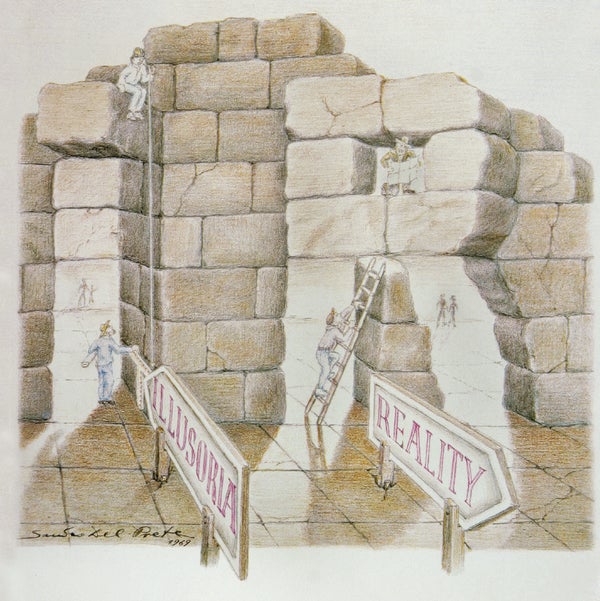
Is not this whole world an illusion? And yet it fools everybody.
—Angela Carter, English novelist (1940–1992)
We are our nervous system. Our brain “drives” our body in an evolutionary quest for food and mates. If you could remove parts of your nervous system one by one, what minimal set would need to remain for you to still be you? Quadriplegic patients don't lose consciousness or emotions, despite spinal cord damage interrupting the brain signals to their limbs and torso. Your spinal column is not critical to who you are. Brain damage from stroke or trauma can cause the inability to see, hear or smell, but these sensory deficits do not affect our fundamental sense of self.
On supporting science journalism
If you're enjoying this article, consider supporting our award-winning journalism by subscribing. By purchasing a subscription you are helping to ensure the future of impactful stories about the discoveries and ideas shaping our world today.
If you took a neuron, put it in a dish and nourished it (as many neuroscientists, including us, have done), you would find that it hums along and lives its life just fine as long as the environmental conditions remain favorable. It will even form circuits, connecting with other neurons you stick in the dish. Drop in some glutamate, the most common neurotransmitter in the brain, and the neuron will excitedly fire off a volley of impulses. But did it intend to fire? Did it consciously decide to express its delight, like a tiny gourmand tasting a delicacy by its favorite chef? Or did the neuron act as any inanimate machine might, like a heliotropic blade of grass following the sun across the sky?
Let's put that neuron back in the brainpan, which, by the way, is just a dish that will nourish it and keep the conditions favorable. That cell will form specific connections and microcircuits that somehow result in conscious feeling. Those circuits are now animate, just like those underlying the first-person experience of your life. How can that be?
The answer is that we don't know. Sorry, but this is what research is about: if we knew the answer, we would be historians rather than scientists. What we do know is that everything you have ever seen, heard, felt or thought was experienced by neurons in your brain, which is a natural miracle in and of itself. Neurons gather information from your senses, intellect and memory and so create a grand simulation of the world around you, forming the basis of your entire subjective universe. How neural circuits create conscious awareness from insentient neurons is perhaps the most important question in science. So how do we answer it?
When we experience an illusion, our perception fails to match the physical reality. This key dissociation makes illusions a powerful tool to isolate the critical brain areas that give rise to our sentience. It allows scientists like us to discriminate among the neural circuits processing information about reality versus our perception of that reality. Neuronal responses that correlate to the physical reality of an object (such as its physical luminance) and not to our perception of it (such as its illusory brightness) cannot be responsible for our conscious experience. The best way to figure out how our brain constructs our experience of the universe is, ironically, by studying illusory perception. In this issue are our best examples of the twisted, bizarre and truly weird illusions that help us understand who we are.
Contributing Authors
Leandro L. Di Stasi is a Talentia/Marie Curie Fellow at the University of Granada in Spain. He works in the emerging field of neuroergonomics
Ellis C. Gayles is a U.S. Navy Aerospace physiologist who has trained naval and marine corps aircrew in the aeromedical aspects of flight, performance enhancement and mishap and in combat-survival techniques.