New Issue: Orbital Catastrophe Ahead? Read Now

Clusters of Epic Volcanic Explosions Drove Earth's Mass Extinctions

Huge regions with epic volcanic explosions are now blamed for four of Earth's “big 5” mass extinctions

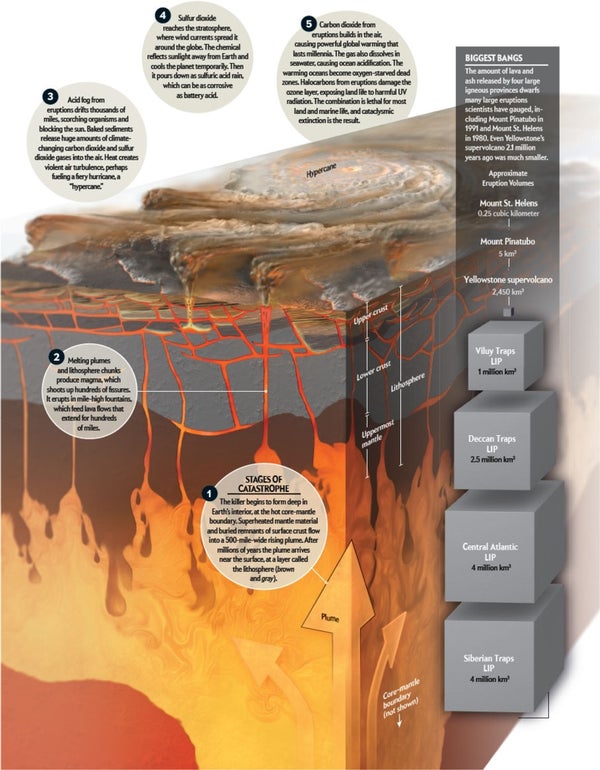
STAGES OF CATASTROPHE The killer begins to form deep in Earth's interior, at the hot core-mantle boundary. Superheated mantle material and buried remnants of surface crust flow into a 500-mile-wide rising plume. After millions of years the plume arrives near the surface, at a layer called the lithosphere (brown and gray).

Melting plumes and lithosphere chunks produce magma, which shoots up hundreds of fissures. It erupts in mile-high fountains, which feed lava flows that extend for hundreds of miles.

Acid fog from eruptions drifts thousands of miles, scorching organisms and blocking the sun. Baked sediments release huge amounts of climate-changing carbon dioxide and sulfur dioxide gases into the air. Heat creates violent air turbulence, perhaps fueling a fiery hurricane, a “hypercane.”

Sulfur dioxide reaches the stratosphere, where wind currents spread it around the globe. The chemical reflects sunlight away from Earth and cools the planet temporarily. Then it pours down as sulfuric acid rain, which can be as corrosive as battery acid.

Carbon dioxide from eruptions builds in the air, causing powerful global warming that lasts millennia. The gas also dissolves in seawater, causing ocean acidification. The warming oceans become oxygen-starved dead zones. Halocarbons from eruptions damage the ozone layer, exposing land life to harmful UV radiation. The combination is lethal for most land and marine life, and cataclysmicextinction is the result.

Join Our Community of Science Lovers!

The biggest extinctions in our planet's history have been blamed, at various times, on asteroids, gas-emitting microbes or volcanic eruptions. The five mass die-offs destroyed most animals and plants on Earth, including the dinosaurs 66 million years ago. New evidence points strongly to cataclysmic eruptions as the real culprits.Highly accurate rock dates pin such eruptions to the same times as four of the major extinctions and tie the explosions to lethal changes in the atmosphere, as the illustrations here show.

For example, 251.9 million years ago life collapsed in the Permian extinction. More than 95 percent of marine species and 70 percent of land species vanished. At around this period, there was a tremendous amount of volcanic activity in a region called the Siberian Traps. To see if the geologic activity began before the extinction and could have been at fault, geochronologists Seth Burgess and Samuel Bowring of the Massachusetts Institute of Technology and their colleagues went to Siberia to nail down the timing.

The scientists collected tiny crystals of zircon and perovskite from erupted rocks. When the crystals are formed, they contain uranium, which converts to lead at a steady rate after the crystals cool on Earth's surface; the ratio of uranium to lead reveals how long ago the eruption occurred. Most of the erupted rock made it to the planet's surface starting just 300,000 years before the extinction peaked, the team reported in August 2015 in the journal Science Advances. Geochemists have also found signs of a huge burst of carbon dioxide—another lethal eruption consequence—into the atmosphere at this time, a pattern repeated for the extinctions at the end of the Devonian, Triassic and Cretaceous periods.


On supporting science journalism

If you're enjoying this article, consider supporting our award-winning journalism by subscribing. By purchasing a subscription you are helping to ensure the future of impactful stories about the discoveries and ideas shaping our world today.


These are not everyday eruptions. The blowups come from giant fields, sometimes thousands of miles across, strewn with volcanic vents. Geologists call these areas “large igneous provinces” (LIPs). Their remnants today form vast swaths of hardened lava in remote areas of Asia and elsewhere. Large igneous province eruptions are spectacular: magma bursts into the air in mile-high incandescent fountains, yellow-hot lava forms long rivers, and a scorching, sulfurous haze drifts for miles. But it is not the lava or ash that makes extinctions truly “mass”; the sulfur dioxide and carbon dioxide gases drive the lethal death spirals.

Some of the new dates have prompted geophysicist Mark Richards of the University of California, Berkeley, and geologist Walter Alvarez, who helped originate the asteroid impact theory of dinosaur demise, to refine that idea. In an April 2015 paper published in GSA Bulletin, their team suggests that energy from the asteroid slamming into the planet accelerated the most violent eruptions in the Cretaceous era. Thus combined with volcanoes, the impact theory, unlike the dinosaurs, lives on.

Subscribe to Support Independent Journalism

Great science journalism requires human expertise, time, effort and creativity. And it costs money. That’s why I and the journalists here at Scientific American hope you’ll join our community.

When you subscribe, you are supporting staff and freelance journalists who are passionate about telling science stories that are true, important and compelling. Our editors and reporters are often experts in their fields, which means they understand the nuances of big discoveries and can untangle the breakthroughs from the hype. With a subscription, you are also supporting rigorous fact-checking to ensure the words we publish are precise and accurate. And you’re supporting original illustrations, graphics and photos that bring you closer to an advanced laboratory, an ice sheet in Antarctica or a space mission in orbit. You’re helping us craft other types of high-quality journalism as well: Our newsletters are carefully written, edited and curated by staffers you have or will come to know and love. Our Science Quickly podcast is based on original reporting, collaboration with editors and scientists and exacting production.

Subscriptions keep this engine running so we can continue to deliver thoughtful, rigorous and independent science journalism to you. In an era of viral misinformation, this work is crucial. If you value what we do, I hope you’ll consider joining us as a subscriber

Thank you,

Jeanna Bryner, Editor in Chief, Scientific American

Subscribe