
Choosing between instant gratification and future benefit can easily lead to shortsighted decisions: streaming TV instead of going to the gym, for example, or scrolling through social media rather than working on a challenging project. “Because of this misalignment between immediate reward and long-term value, people often struggle to do what's best for them in the long run,” says Falk Lieder, a cognitive scientist at the Max Planck Institute for Intelligent Systems in Tübingen, Germany.
To guide individuals toward optimal choices, Lieder and his colleagues designed a digital tool they call a “cognitive prosthesis.” It helps to match a decision's immediate reward with its long-term worth—using artificial intelligence to augment human decision-making through a to-do list. The researchers developed a set of models and algorithms that consider various elements such as a list of tasks, an individual's subjective aversion to each and the amount of time available. The system then assigns reward points to each task in a way that is customized to encourage that person to complete them all.
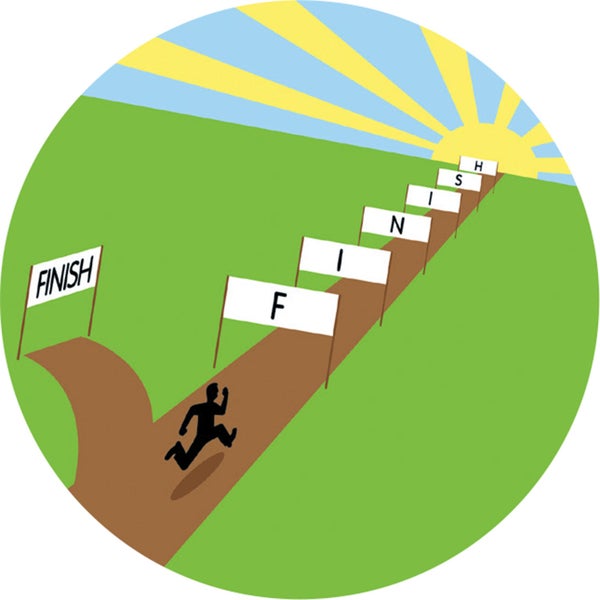
“The idea was to turn the challenging projects that people pursue in the real world into a gamelike environment,” Lieder says. “The point system [gives] people proximal, attainable goals that signal that they're making progress.”
On supporting science journalism
If you're enjoying this article, consider supporting our award-winning journalism by subscribing. By purchasing a subscription you are helping to ensure the future of impactful stories about the discoveries and ideas shaping our world today.
The team tested the setup in a series of experiments with human subjects. The results, published online in August in Nature Human Behaviour, revealed that the AI support system helped people make better, faster decisions and procrastinate less—and it made them more likely to complete all the assigned tasks. In one experiment, in which the researchers presented 120 participants with a list of several writing assignments, they found that 85 percent of individuals who used the tool completed all their tasks; the rate was only 56 percent for those not using it.
The difference in completion rates was “quite impressive,” says Mike Oaksford, a psychologist at Birkbeck, University of London, who was not involved in the study. “That seems to me to be a convincing demonstration that procrastination is something that this strategy [can] help with quite a lot.”
Lieder says one of the current tool's limitations is that it can handle only short to-do lists, so he and his team are trying to scale it up for a larger number of tasks. At the same time, they are working with a company called Complice to integrate the tool into an existing to-do list app. The researchers also plan to run field experiments to see how well their cognitive prosthesis fares in the real world.