
A new color-changing ink could aid in health and environment monitoring—for example, allowing clothing that switches hues when exposed to sweat or a tapestry that shifts colors if carbon monoxide enters a room. The formulation could be printed on anything from a T-shirt to a tent.
Wearable sensing devices such as smartwatches and patches use electronics to monitor heart rate, blood glucose, and more. Now researchers at Tufts University’s Silklab say their new silk-based inks can respond to, and quantify, the presence of chemicals on or around the body. Silk’s ability to “act like a protective ‘cocoon’ for biological materials” means the necessary sensing and color-changing materials can be added to the ink without losing their function, says Fiorenzo Omenetto, a biomedical engineer at Silklab and senior author of a new paper on the technology.
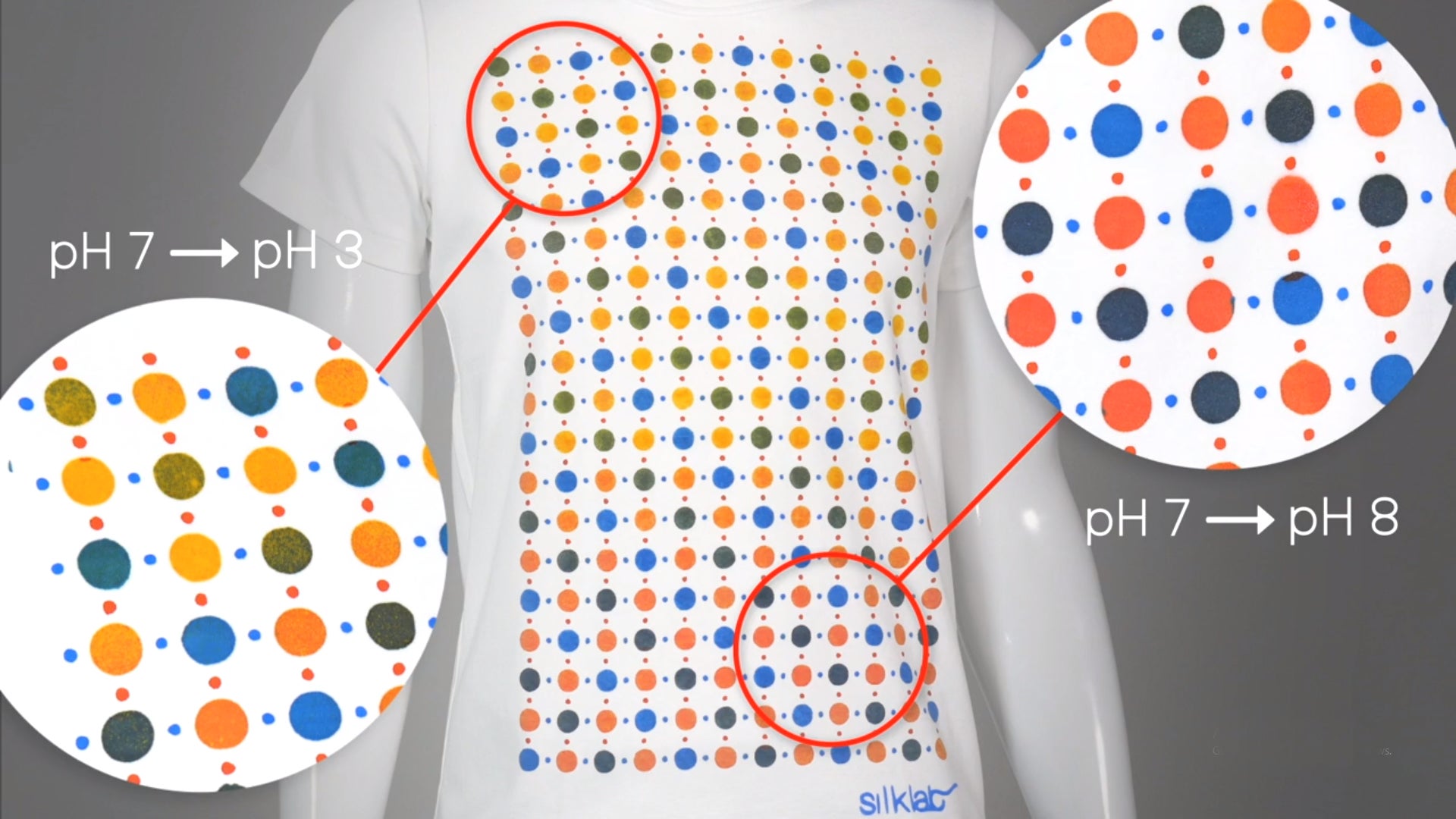
Illustration of how pH-sensitive ink changes, based on exposure. Credit: Silklab Tufts University
On supporting science journalism
If you're enjoying this article, consider supporting our award-winning journalism by subscribing. By purchasing a subscription you are helping to ensure the future of impactful stories about the discoveries and ideas shaping our world today.
The researchers had created an earlier version of the material that inkjet printers could spray on fabric, turning small items, such as patches or gloves, into sensors. For the recent study, published online in May in Advanced Materials, they thickened the ink with the chemical sodium alginate to make it work in screen printing and thenadded various reactive substances. With the new ink, they can now “easily print a large number of reactive elements onto large surfaces,” Omenetto says.
The team made silk ink by breaking down raw fibers into constituent proteins, which the researchers suspended in water. Next they mixed in reactive molecules (such as pH-sensitive indicators and lactate oxidase) and analyzed how the resulting products changed color when exposed to alterations in their environment. When printed on fabric and worn, pH indicators could lend insight into skin health or dehydration; lactate oxidase could measure a wearer’s fatigue levels. The changes are visible to the naked eye, but the researchers also used a camera-imaging analysis to continuously monitor the color variations and create a database of values.
“In the case of a T-shirt, the wearer ‘paints’ the shirt [through] exercise—with colors correlating to the acidity distribution of their sweat,” Omenetto says. He envisions using the ink to help monitor such activity. It could also be adapted to track environmental changes in a room, he says—or to respond to bacteria and follow disease progression.
Mechanical engineer Tyler Ray of the University of Hawaii at Manoa, who was not involved with the study, notes that most of today’s wearable monitors are rigid, wired and relatively bulky. The new ink technology has “the potential to transform consumer wearables from recreational novelty devices into body-worn, clinical-grade physiological measurement tools that yield physician-actionable information,” he says. But “one of the challenges with any colorimetric approach is the effect various environmental conditions have on accuracy, such as lighting … or the camera used.” Future studies would need to address these issues.