
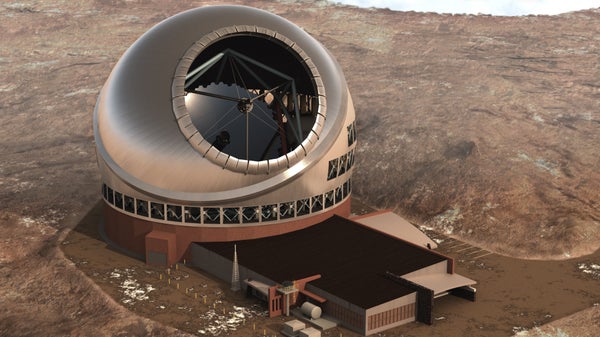

A $1.4 billion telescope project has finally gotten the go-ahead to resume construction high up on Hawaii's Mauna Kea volcano.
The state's Board of Land and Natural Resources (BLNR) announced Friday (Sept. 29) that it has decided to approve a construction permit for the Thirty Meter Telescope (TMT), which has been in limbo for several years.
TMT broke ground in October 2014, but demonstrations the following spring halted the build. Protesters have cited concerns about the telescope project's cultural and environmental impact; Native Hawaiians regard peaks throughout the island chain as sacred. [Thirty Meter Telescope: Hawaii's Giant Space Eye (Gallery)]
On supporting science journalism
If you're enjoying this article, consider supporting our award-winning journalism by subscribing. By purchasing a subscription you are helping to ensure the future of impactful stories about the discoveries and ideas shaping our world today.
Then, in December 2015, the Hawaii Supreme Court pulled TMT's original construction permit indefinitely, saying the BLNR granted it without properly addressing a petition filed by opposition groups. And in December 2016, a judge with Hawaii's Third Circuit Court ruled that a sublease agreement between TMT and the University of Hawaii was invalid because the BLNR allowed it without holding a "contested case hearing."
As this history suggests, a favorable ruling by the BLNR does not guarantee smooth sailing into the future for TMT. Indeed, opponents of Friday's decision are already planning to appeal it to the Hawaii Supreme Court, Sky & Telescope noted.
If building on Mauna Kea becomes impossible or impractical, the project could relocate to its backup site—the Observatorio del Roque de los Muchachos on La Palma, in the Canary Islands.
TMT will integrate 492 mirror segments into a single light-gathering surface 98 feet (30 meters) wide. When it's operational in the early to mid-2020s, the giant scope will be put to a variety of uses, from detecting and characterizing exoplanets to studying mysterious dark matter and dark energy, project representatives have said.
TMT is one of three ground-based megascopes scheduled to come online in the 2020s. The others—the Giant Magellan Telescope and the European Extremely Large Telescope — are both being built in the Chilean Andes.
EDITOR'S RECOMMENDATIONS
Thirty Meter Telescope Tech Explained By Fmr. NASA JPL Director | Video
World's Largest Reflecting Telescopes Explained (Infographic)
Copyright 2017 SPACE.com, a Purch company. All rights reserved. This material may not be published, broadcast, rewritten or redistributed.