
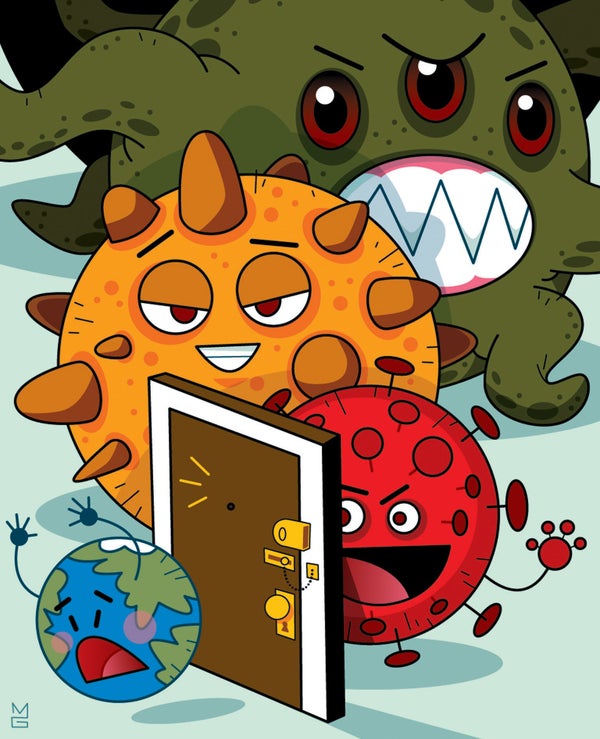
After Omicron comes pi in the Greek alphabet. And then rho, sigma, tau.... Before SARS-CoV-2 finishes its grand tour through the Greek alphabet, the global public health establishment should do what it should have done long before this coronavirus emerged. It must put in place the basic health systems needed to detect new outbreaks and deploy technologies that allow for vaccines and medicines to be manufactured and administered in low- and middle-income countries.
Because they have often refused to treat COVID as a common threat that demands a unified response, policy makers have yet to thwart the predations of a virus that, to channel the Greeks again, affects all (pan) people (demos). This myopia means that these mistakes could be repeated when a new pandemic arrives.
The next time could be worse. The National Academy of Medicine predicted in November 2021 that a flu epidemic akin to the one in 1918 and 1919 could prove more catastrophic than COVID-19. The preconditions for such a disaster are in place. A warming planet, megacities, mass migration, intercontinental travel and habitat loss are among the reasons that infectious diseases, like intensifying typhoons and hurricanes, have become part of our lives.
On supporting science journalism
If you're enjoying this article, consider supporting our award-winning journalism by subscribing. By purchasing a subscription you are helping to ensure the future of impactful stories about the discoveries and ideas shaping our world today.
Fast-tracked development of diagnostics, vaccines, monoclonal antibodies and antiviral drugs marks an undisputed medical triumph of the COVID era. Also notable, however, is the failure of governments and international organizations to use our current predicament to rectify glaring public health deficiencies.
The Global Health Security Index for 2021 rated the world's 195 countries as “dangerously unprepared” to deal with future epidemic and pandemic threats. The average score for individual countries came in at 38.9 out of 100, about the same as the 2019 rating—before the pandemic began. Many countries failed to grasp that the pandemic presented an unparalleled opportunity to lay the groundwork for coping with not only this public health crisis but also future ones.
Readiness for a COVID-30 or a new pandemic flu strain—or, for that matter, an out-of-control bioweapon—will require new generations of surveillance tools, diagnostics and drugs, as well as, say, a “universal” coronavirus vaccine that can counter any strain. Having sufficient available vaccine formulations with long shelf lives would also help alleviate the inequities that have accompanied distribution of shots. Underscoring the absence of “global” in “global public health,” Portugal had fully vaccinated 89 percent of its population by mid-January 2022 but Mali only 2.8 percent.
The most pressing priority should be a return to basics, both globally and locally. COVID has served as a painful demonstration that public health is as essential to national security as a standing army. And the cost of health security is minimal. In 2016 the Commission on a Global Health Risk Framework for the Future estimated that for 65 cents a year for every person on the planet, we could upgrade national pandemic preparedness programs worldwide. An investment of $4.5 billion—far less than the price of a single new ballistic missile submarine—might prevent the global loss of millions of lives and an economic hit in the trillions of dollars.
The basics entail not only building new systems to prepare for pandemics but a major strengthening of institutions already in place. Public health legal expert Lawrence O. Gostin has noted that the World Health Organization had a 2022–2023 budget of $6.12 billion, which is less than those of some major U.S. teaching hospitals. The WHO needs not just money but reforms that give it the authority to better monitor and intervene when new infectious diseases emerge. At the country level, the most basic of basics consists of functioning national systems that furnish medical care for all and financial help, as needed, for child care, food, housing and other measures to waylay the poverty-related chronic diseases capable of sending even a relatively young adult onto a ventilator during a future pandemic.
After repeated outbreaks of horrific diseases such as SARS, Ebola and Zika, perhaps this calamity will prove traumatic enough to bring about a coherent remake of the current system. Deaths from COVID worldwide by late October 2022 nearly equaled the population of Lebanon—and the pandemic is still with us. Only when global public health commands the attention of policy makers in the same way as a new contract for nuclear submarines will Greek letters return to their more familiar role in American life as naming conventions for student groups on college campuses.