
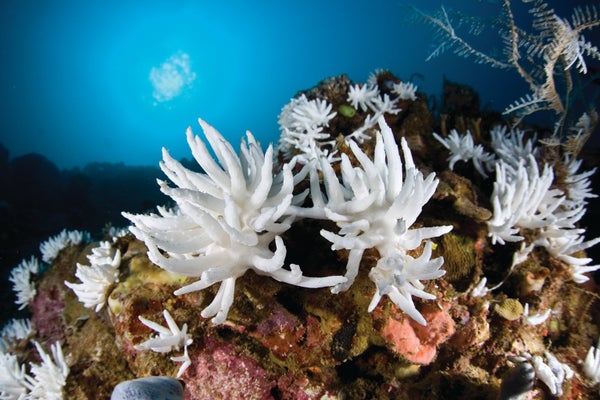
As the planet and oceans continue to heat up, sites where coral has recently thrived are becoming less and less habitable. For instance, thanks to extreme ocean temperatures, much of Australia's Great Barrier Reef suffered mass bleaching in 2016 and 2017 that turned parades of colorful coral into dull, white masses.
But paleontologists have now discovered a haven to which one region's reefs might relocate—via oceanic currents when corals are still in their free-floating larval stage—to escape overheating. By studying fossils in Daya Bay, just northeast of Hong Kong in the South China Sea, a team of researchers found that during periods of warming in the distant past, coral reefs migrated away from equatorial warm waters to the bay's more hospitable subtropical latitudes.
“We showed that the higher-latitude reefs up around China did grow during earlier warm periods,” says Tara Clark, a paleoecologist at the University of Wollongong in Australia. In 2015 Clark led a group of scientists on an expedition to Daya Bay. There the researchers randomly collected dead corals and calculated their ages using radioisotopic dating techniques. The ancient reefs grew between 6,850 and 5,510 years ago, the scientists reported in January in Geology, which coincides with a time when ocean temperatures around South China and nearby seas were one to two degrees Celsius warmer on average than they are today. This trend suggests that some of today's reefs may be able to set up shop in places such as Daya Bay in the decades to come, as temperatures climb.
On supporting science journalism
If you're enjoying this article, consider supporting our award-winning journalism by subscribing. By purchasing a subscription you are helping to ensure the future of impactful stories about the discoveries and ideas shaping our world today.
The idea of refuges for imperiled reefs on the move is not new, but using the fossil record to help pinpoint such places is a relatively novel approach, says John Pandolfi, a marine paleoecologist at the University of Queensland in Australia, who was not involved in the new work. “It's absolutely fundamental to understanding the dynamics of ecological communities and their responses to ecological change,” he says. Such change often occurs on broader timescales than those of humans, and the fossil record can reveal that long-term change, Pandolfi notes.
Although the fossil evidence suggests that Daya Bay could one day provide a haven for corals, there are some hurdles in the way of making the refuge an inviting place, Clark says. Not all corals, for instance, are equally fit to trek across the ocean to a new home. And Daya Bay is now heavily polluted, which could jeopardize its ability to sustain reefs. But in light of the new discovery, Clark says, “we might as well do the best we can to protect these areas, just in case.”