
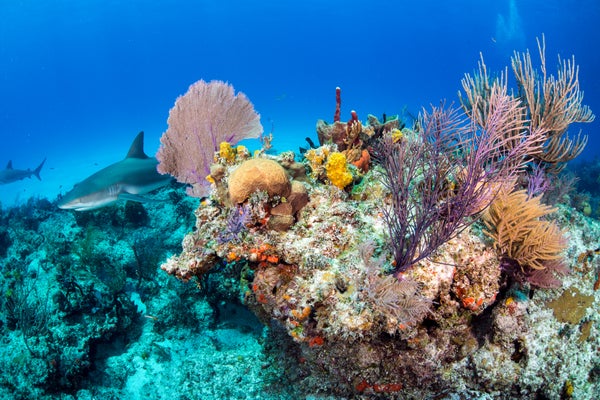
Coral reefs aren't just bleaching—they're literally dissolving away because of climate change. And before the end of the century, most reefs around the world may be dissolving faster than they can build themselves back up, according to new research.
It's an often overlooked—but potentially serious—consequence of ocean acidification, says a new study published yesterday in the journal Science. Ocean acidification occurs when carbon dioxide dissolves out of the atmosphere and into the ocean, where it chemically reacts and lowers the water's pH. The process is sometimes dubbed the "evil twin" of climate change because of the harmful effects it may have on marine ecosystems.
One widely discussed concern is that acidification may make it harder for certain marine organisms—including coral, as well as shellfish and certain types of plankton—to build the hard outer shells they need to survive. That's because the process tends to deplete a certain type of chemical compound in the water called calcium carbonate, which is a major building block these animals use to make their shells.
On supporting science journalism
If you're enjoying this article, consider supporting our award-winning journalism by subscribing. By purchasing a subscription you are helping to ensure the future of impactful stories about the discoveries and ideas shaping our world today.
Scientists are now realizing that acidification not only hinders corals from building themselves up—it can also help tear them down. As calcium carbonate levels drop, existing coral structures start to dissolve away into the water. These include the living corals' skeletons, but also the sediment platforms they build on top of, which form the bulk of the reefs.
"There's very little research that's being done on basically carbonate sediment dissolution," said lead study author Bradley Eyre, a researcher at Southern Cross University in Australia. Most research on the effects of ocean acidification so far has focused on its impact on calcification, or the building process.
To investigate the possible dissolving effect, the researchers monitored 57 locations at five coral reefs around the world, including sites near Hawaii, Bermuda, Australia and the Cook Islands. They found a strong correlation between the dissolving process and calcium carbonate levels in the water. In fact, the dissolving process seems to be even more sensitive to ocean acidification than the building process—the effect on dissolving is up to 10 times stronger.
This may be the study's most important finding, according to coral expert Chris Langdon of the University of Miami.
"We've been making projections on when reefs would get in trouble based on the sensitivity of calcification," he told E&E News. "So we might be drastically underestimating the seriousness of the problem, given that dissolution is 10 times more sensitive."
The researchers also discovered that there tends to be a kind of tipping point, or a specific low point in local calcium carbonate levels, beyond which coral reefs start dissolving faster than they can build. The study site in Hawaii has already hit this point, they noted.
Using this information, the researchers created a model to predict future changes in calcium carbonate levels and global reef responses. For now, conditions in the tropical oceans still generally favor more building than dissolving. But at current rates of acidification, average water conditions are expected to reach the tipping point by 2080 or so, at which point reefs will start to dissolve faster than they can build themselves up.
That's just looking at average water chemistry throughout the world's tropical waters, the researchers are careful to note. While the oceans are generally acidifying all over the world, water chemistry can differ widely from one location to the next, influenced by pollution, organic matter in the water and other regional factors.
This means not every reef will necessarily hit its tipping point at the exact same time. Still, the research suggests that many of them are on track to meet such a fate within this century.
And the corals around Hawaii may not be the only ones already at that point. A 2016 study, co-authored by Langdon, found that parts of the Florida Reef Tract—the third-largest barrier reef ecosystem in the world—are eroding away, particularly during the fall and winter months. And more recent monitoring efforts suggest the process is still occurring and may even be affecting more of the reef than before, Langdon said.
How severely this dissolving process will affect the reefs—both in Florida and around the world—remains in question, Eyre said. Because scientists are just starting to document the process, it's unclear how rapidly reefs may erode once the process starts. But it's likely that other ongoing impacts of climate change, such as coral bleaching, may weaken reefs even further in the future and make them more vulnerable to the dissolving process.
In light of such uncertainty, Eyre said, the best course of action is to continue working to slow ocean acidification, and climate change generally, before its effects grow too much worse.
"I think the take-home message ... is that we really need to reduce the amount of CO2 that we're putting into the atmosphere," he said.
Reprinted from Climatewire with permission from E&E News. E&E provides daily coverage of essential energy and environmental news at www.eenews.net.