
When science is taught in school, it's usually presented as a logical sequence of hypotheses and experimentation. One delightful surprise when you start learning more about the process of science is that it's unpredictable, messy and weird. Some scientists prefer to highlight ways their research worked as expected—but it's a much better story when a scientist tells you everything that was spectacularly strange. Neurobiologist Kenneth C. Catania explains how a parasitic wasp turns its cockroach prey into a zombie, how the cockroach tries to protect itself from the precision attack, and how the process of studying this conflict became more improvisational and goofy with every discovery. It's appropriate that the wonderful graphic by Matthew Twombly depicting this Battle of the Bugs looks like it's from a comic book.
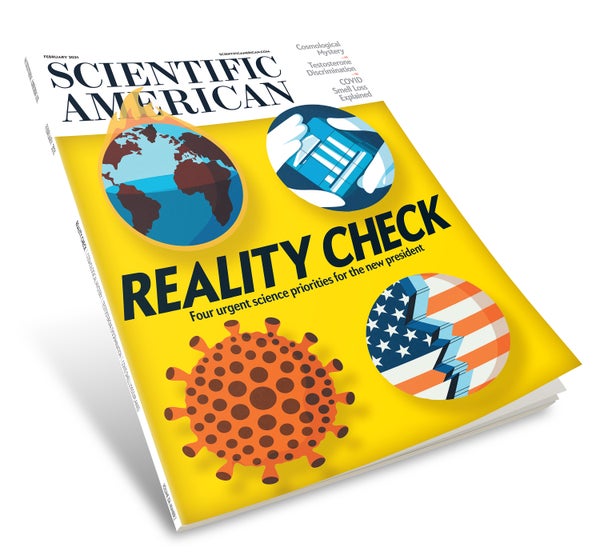
The more we've learned about the universe in the past 175 years since Scientific American was founded, the more mysteries and conundrums we've faced. One of the biggest puzzles right now has to do with three interrelated concepts: vacuum energy (which describes the stuff in otherwise empty space), dark energy (which is pushing the expansion of the universe) and the cosmological constant (Einstein's fix for making the math of relativity work out). The so-called cosmological constant problem is “generally regarded as one of the most awkward, embarrassing, difficult problems in theoretical physics today,” physicist Antonio Padilla tells senior editor Clara Moskowitz, who guides us expertly through the stubborn challenge of accounting for the state of the universe.
The private space industry is growing quickly, with a lot of experimentation but not a lot of regulation, and to aerospace scientist Martin N. Ross and space journalist Leonard David, it can apply lessons from the early days of commercial aviation. They point out the problems with exhaust, particulates and other emissions from rocket launches and argue that the industry will be more successful and sustainable if it controls pollution immediately.
When (and if) the postponed Summer Olympics are held in Tokyo this year, some of the world's best athletes will be prohibited from competing because of their natural levels of testosterone. The Court of Arbitration for Sport claimed that science underpinned its recent decision to require athletes to suppress their hormone levels if they want to compete in certain women's events. Neuroscientist Grace Huckins shows why there's little science to support this form of discrimination.
Muddy Waters and Chrissie Hynde, among other musicians, have played guitars made of “swamp ash,” a lightweight wood that grows in Mississippi River lowlands and gives a warm, clear sound. Lately seasonal flooding exacerbated by climate change, as well as an invasive beetle, has threatened these trees. Guitar makers are adapting, reports Priyanka Runwal, but it's another example of how climate change is disrupting basically everything.
As Joe Biden and Kamala Harris take office, they have many problems to solve, and some of the most urgent involve science: climate change, the COVID pandemic, misinformation and mistrust, and rebuilding the science capacity in the federal government. Scientific American editors Andrea Thompson, Tanya Lewis and Jen Schwartz, respectively, take on the first three issues. A former head of the National Oceanic and Atmospheric Administration, Jane Lubchenco, recounts her experiences with Biden when he was vice president and shares some excellent advice about how he can use science to make the country better.
One of the strangest symptoms of COVID is persistent loss of smell and taste. There's some good news—the virus isn't invading the brain, as people worried at first. Damaged cells in the nose can recover, although the returning sense of smell can sometimes be distorted. For one poor patient, everything tasted like window cleaner. It's one more reason to be careful out there and try to avoid this dreadful virus. Be well.