
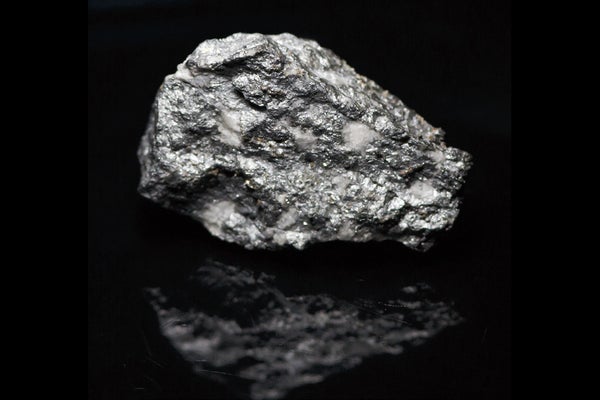
An electric car future is speeding closer; economic analysts project that a third of all automobiles could be battery-powered by 2040. Most of these vehicles rely on large lithium-ion batteries, prompting worries about whether the world's lithium supply can keep up. But another element—cobalt—is a bigger concern, scientists reported in October in the journal Joule.
“The best lithium battery cathodes [negative electrodes] all contain cobalt, and its production is limited,” says study lead Elsa Olivetti, a materials scientist and engineer at the Massachusetts Institute of Technology. Olivetti and her colleagues calculated just how short cobalt supplies could fall if electric vehicles (EVs) take off as expected—and the findings are sobering.
Lithium battery cathodes are made of layers of lithium metal oxides that contain some combination of cobalt and other metals. Cobalt's unique atomic properties let cathodes pack a lot of energy into a small space and help to maintain the cathodes' layered structure.
On supporting science journalism
If you're enjoying this article, consider supporting our award-winning journalism by subscribing. By purchasing a subscription you are helping to ensure the future of impactful stories about the discoveries and ideas shaping our world today.
Olivetti and her colleagues extrapolated trends in lithium and cobalt supply through 2024. To calculate demand, they created two scenarios based on estimates of slow or speedy growth in battery use for EVs and portable electronics.
Lithium is unlikely to be a limiting factor in the long run, they found. But even with a very conservative estimate of 10 million EV sales in 2025, the demand for cobalt that year could reach 330,000 metric tons, whereas the available supply at that time would be at most 290,000 metric tons.
Cobalt is a by-product of copper and nickel mining, so its production depends on the demand for those metals. Furthermore, more than half of the world's cobalt stores are found in the politically unstable Democratic Republic of the Congo.
Recycling lithium batteries is complicated and rarely done. Even with higher rates and cheaper processes, “recycling won't make a dent until 10 or more years after mass-market penetration of EVs,” says Linda Gaines, a transportation systems analyst at Argonne National Laboratory, who was not involved in the work.
Newer cathode chemistries offer hope, however. Recently developed nickel-rich formulations will reduce cobalt demand, Gaines says. Cobalt-free cathodes are also under development, and researchers hope to make them practical.