
ATLANTA — The yellow pills had already killed four before landing in Brian Hargett’s lab last month. They were clearly counterfeit — the letters P-E-R-C-O-C-E-T were as crooked as the dealer who had peddled them throughout central Georgia — but now his chemists had to figure out exactly what they were. And fast. Lives were still at stake; health officials wanted to alert the public about the phony pills. First, though, they had to know what was in them.
At the Georgia Bureau of Investigation’s forensic lab outside Macon, Hargett assigned the tablets to one of his forensic chemists. She threw on her gown and gloves, weighed a pill, and dropped it in a skinny vial to soak in ethanol. Then she ran a test designed to separate and identify each substance in the pill. Two synthetic opioids showed up — including one never before seen in Georgia.
Their best guess: the little-known, and lethal, compound known as cyclopropyl.
On supporting science journalism
If you're enjoying this article, consider supporting our award-winning journalism by subscribing. By purchasing a subscription you are helping to ensure the future of impactful stories about the discoveries and ideas shaping our world today.
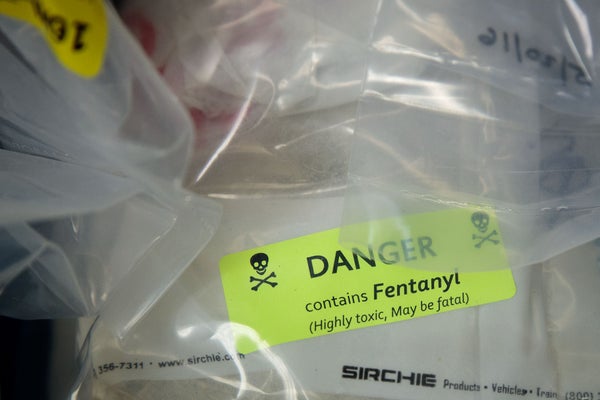
As newer and stronger opioids flood states from Arizona to New York to Ohio, crime labs like this one find themselves racing to identify unfamiliar drugs in hopes of saving lives. They need to know what’s on the streets in order to build legal cases against the dealers. But identifying the drugs is also vital for public health: It lets first responders know how much of the overdose antidote naloxone to carry. And it helps them understand how lethal the drug residue might be — a crucial bit of information in an era when police officers have overdosed simply from incidental exposure at a crime scene.
“What happens when fentanyl changes on a weekly or monthly basis? You need 2017 data in a 2017 crisis response,” said Dr. Daniel Ciccarone, professor of family and community medicine at the University of California, San Francisco.
Read more:STAT forecast: Opioids could kill nearly 500,000 Americans in the next decade
That’s tough when manufacturers in China and kitchen labs in the U.S. are churning out a dizzying array of opioid analogs. By tweaking the chemicals slightly, they can bump up the potency or, in some cases, evade narrowly written laws that make only certain compounds illegal.
Some of the analogs have cut such a deadly swath through the U.S. that they’re now widely familiar: fentanyl, for instance — and increasingly, carfentanil, an elephant tranquilizer that can be fatal to humans in minuscule doses.
Others bear obscure names, like furanylfentanyl or ohmefentanyl or U-47700, which has killed teenagers in a Utah ski town and a Detroit suburb. They can be 10,000 times more potent than morphine. And once they reach a community, they can trigger a wave of overdoses — dozens within a couple hours, scores within a few days — that overwhelm first responders and strain health care resources.
Detectives and doctors learn to team up
To fight back, crime lab chemists are forging unprecedented partnerships with public health officials.
In Baltimore, emergency room doctors and firefighters who respond to 911 calls now report overdose spikes to Health Commissioner Dr. Leana Wen. She has the power to dispatch outreach workers to the hardest-hit neighborhoods the very same day. They distribute the naloxone, train people to use it — and explain treatment options to those ready to listen.
“We act on that information in real time,” Wen said. “Even if it’s imperfect data, that data is critical in a time of a public health emergency.”
The state of Nevada, too, is considering mandating hospitals to report drug overdoses in real time to help health officials spot overdose trends.
And in Quincy, Mass., narcotics detectives bring along a $22,000 TruNarc analyzer that can identify many drugs right at the scene, which lets the department quickly send out public alerts about deadly analogs that appear to be flooding the streets, perhaps disguised as prescription painkillers. “It used to take time — months — and now we’re looking at seconds,” said Lt. Patrick Glynn. “We can identify a drug right away.”
Glynn, the director of the South Shore Drug Task Force in Massachusetts, minces no words on the importance of this development to public health.
“Faster is better,” he said.
The spur for all this activity is clear: In just two years, from 2013 to 2015, fatal overdoses of synthetic opioids tripled in the U.S., to nearly 10,000, according to the Centers for Disease Control and Prevention. And some experts who recently forecast opioid deaths over the next decade for STAT predict that fentanyl and its analogs will drive up fatal overdoses still further.
Read more:The game changers: 12 bold attempts to slow the opioid epidemic
But even with that sense of urgency, some jurisdictions have hit hurdles in collecting and sharing crucial data.
First responders can’t always share information about the overdose victims they see, due to patient privacy laws. And states often lack resources to pull together reports coming from coroners, police departments, hospitals, and paramedics in multiple jurisdictions. It’s tougher still to do that in real time.
Federal data reporting, meanwhile, lags far behind. The most recent published statistics are from 2015.
“We often don’t have a clear picture of how big the opioid problem is until months have passed,” said Brian Smith, a public health advocate who has called for better surveillance of overdose outbreaks. “That’s so fundamentally different as to how we treat any other epidemic; if we’re going call this an opioid epidemic, we should treat it as one.”
An ‘extremely potent’ mystery drug
Then there’s the fact it’s hard to quickly identify a drug you’ve never seen before.
Here in Georgia, officials knew there was something dangerous circulating when 911 overdose calls began to trickle in over the weekend of June 3. By the following Monday, they’d pieced together a picture of a string of overdoses, scattered throughout the central part of the state.
Hargett first got word on June 6, as he scrolled through social media on his lunch break. First responders described scenes of unconscious men and women: Some were unresponsive, others had difficulty breathing. Authorities said at least 30 overdoses seemed to be related.
Read more:China bans more synthetic opioids blamed for U.S. drug deaths
Whatever the unknown drug was, it was “extremely potent and has required massive doses of naloxone to counteract its effects,” said Nancy Nydam, a spokesperson for the Georgia Department of Public Health.
A retired log cutter named Henry Howard, who bought 10 pills of what he thought were Percocet for $7 each to dull his back pain, told the Macon Telegraph that “my heart went to sleep.” His wife called 911 after finding him unconscious on their bed. He was able to be revived.
Others weren’t as fortunate. Amirrah “Shea Shea” Gillens, a 36-year-old mother of six children, was among those believed to have died from the fake Percocet pills.
As local law enforcement worked to track down the dealer, other detectives collected the yellow pills from buyers and brought them to the crime lab, where Hargett and his team got to work.
After they’d identifying what they thought was cyclopropyl — which has no known medical use for humans or animals — Hargett called the Georgia Bureau of Investigation for help. To confirm the substance’s identity, GBI ordered a reference standard from Cayman Chemical Company, a biotech firm based in Ann Arbor, Mich.
Read more:Do family members have a right to know when a loved one overdoses on opioids?
Roxanne Franckowski, a quality manager at the company, said her forensic lab routinely helps crime labs detect new designer drugs. “When labs start seeing unknown substances pop up,” Franckowski said, “We’ll get calls asking, ‘Do you have X compound?’ We’ll either provide material or make it.”
Fortunately, Cayman had a reference standard of cyclopropyl on file and shipped it overnight to Georgia. Within days, Hargett’s team was able to confirm that the fake Percocet pills contained a mixture of cyclopropyl and U-47700.
No time to celebrate
Based on its initial findings, the GBI had alerted Georgia’s public health department and poison center that the counterfeit pain pills contained synthetic opioids. They blasted out the news to the public. Now, within a week of the first overdose, GBI spokesperson Nelly Miles was able to share publicly the exact contents of those pills.
“Both of these drugs are HIGHLY DANGEROUS and should not be handled,” the GBI statement said. “They can be inhaled or absorbed through the skin and are extremely toxic in even the smallest quantities.”
Georgia’s public safety and public health officials believe the message worked. In the end, the pills killed five people. But it could have been worse.
“The cluster was short-lived,” said Dr. Patrick O’Neal, the state’s director of health protection, “and smaller than what we feared in the beginning.”
There wasn’t time to celebrate, though. Last week, GBI scientists identified two new fentanyl analogs — acrylfentanyl and tetrahydrofuran — in one of its labs in north Georgia .
“As soon as you identify one, another one is coming,” O’Neal said. “They’re coming fast and furious.”
Republished with permission from STAT. This article originally appeared on July 5, 2017