
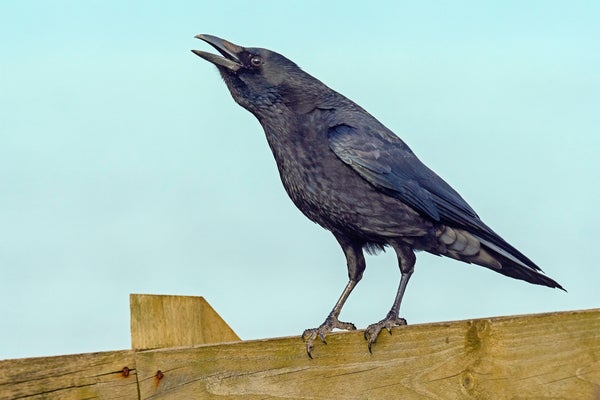
The rock group Counting Crows were onto something when they chose their band name. Crows can indeed count, according to research published this week in Science.
The results show that crows have counting capacities near those of human toddlers who are beginning to develop a knack for numbers, says lead study author Diana Liao, a postdoctoral researcher in neurobiology at the University of Tübingen in Germany. “We think this is the first time this has been shown for any animal species,” she adds.
Crows do not appear to be capable of symbolic counting, in which numbers are associated with a particular symbol that serves as an exact representation. This skill is still thought to be unique to humans. Instead the birds are able to count by controlling the number of vocalizations they produce to correspond to associated cues—just like young children who have yet to master symbolic counting often do, Liao says. For example, a toddler who is asked how many apples are on a tree may answer, “One, one, one” or “One, two, three”—producing the number of speech sounds that correspond to the number of objects they see rather than just saying, “Three.”
On supporting science journalism
If you're enjoying this article, consider supporting our award-winning journalism by subscribing. By purchasing a subscription you are helping to ensure the future of impactful stories about the discoveries and ideas shaping our world today.
Scientists have long suspected that some nonhuman species might also have the ability to count by controlling the number of their vocalizations, but they have lacked the smoking gun evidence to prove it. In a study of Black-capped Chickadees, for example, researchers reported that the number of “dee” notes at the ends of the birds’ alarm calls was inversely correlated with the size of the predator they were issuing warnings about. (The small predators in that study posed a higher risk to the chickadees than large ones did.) “They seemed to be conveying the magnitude of the threat,” Liao says.
Yet this finding on its own did not prove that chickadees were intentionally conveying information about the predator through numbered calls. The behavior could also be driven by the level of fear the birds were experiencing, Liao says, with more dangerous predators triggering higher states of arousal and thus more calls.
In the new study, Liao and her colleagues ruled out these unknowns by running experiments with three carrion crows (Corvus corone) in a carefully controlled laboratory setting. They presented the birds with randomly ordered cues, four of which were visual—colored Arabic numbers that appeared on a touch screen—and four of which were auditory, including a short guitar chord and a drumroll. Through trial and error, the birds had to figure out the correct number of calls, between one and four, to pair with each cue. If they got it right, they received a pellet or worm reward. If not, they received a time-out from the game.
When the birds did get something wrong, they tended to make errors around the target number—a phenomenon referred to as the numerical distance effect. As Liao explains, “It’s easier to confuse three and four than it is one and four.”
After receiving between 166 and 189 training sessions, all of the crows were able to produce the correct number of vocalizations associated with the cues at a level higher than chance—a “pretty cool” finding, Liao says. She suspects, too, that the crows could have mastered numbers higher than four if they were given the opportunity.
Onur Güntürkün, a biopsychologist at Ruhr University Bochum in Germany, who was not involved in the research, says the new paper is “excellent”—even if the findings are “not unexpected” given all that scientists already know about crows and many other species’ intelligence.
“We know that crows can flexibly use both visual and auditory information to solve tasks, can control their vocalizations and can exploit numerical information,” Güntürkün says.
But it’s worth remembering, Güntürkün continues, that mammals and birds separated on their evolutionary trajectories about 324 million years ago, and strong evidence suggests that their last common ancestor “did not have the means to do what the crows of this paper did.”
Counting abilities in birds and mammals thus represent “a spectacular case of convergent brain evolution” in which both groups came up with virtually the same solution to the cognitive challenges posed by life on Earth, he says. “As a result, crows learn, remember, plan, act and err as toddlers do.”