‘Odd’ Gulf of Mexico earthquake rattles Florida and Cuba

This earthquake may be among the biggest in the Gulf of Mexico’s history

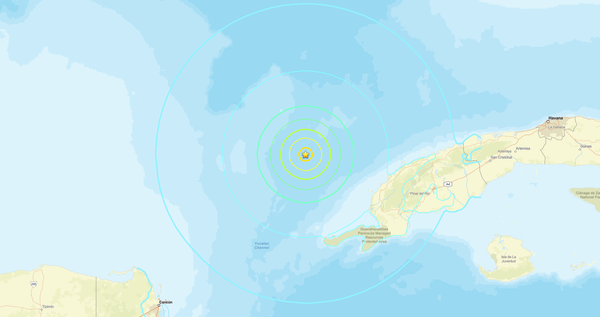
Rings showing center of earthquake near Cuba.

A magnitude 6.1 earthquake that struck off the coast of Mantua, Cuba, on June 8.

Join Our Community of Science Lovers!

A magnitude 6.1 earthquake struck off the coast of Cuba in the Gulf of Mexico on Monday, with "reports of shaking across Southwestern Florida," according to a social media post from the National Weather Service’s (NWS’s) Miami office.

The quake occurred 104 kilometers (about 65 miles) northwest of Mantua, Cuba, says Robert Garcia, a warning coordination meteorologist at the NWS Miami office. It occurred at about 2 P.M. EDT and at a depth of 26 kilometers (around 16 miles) below the surface. “We have not heard any reports of damage in South Florida,” Garcia says. There is no threat of a tsunami from the earthquake at this time.

Jeff Berardelli, chief meteorologist at an NBC affiliate station in Tampa, Fla., posted on Bluesky that the earthquake was among the biggest in the Gulf of Mexico’s history. A 1959 earthquake of around magnitude 6.4 that struck near Veracruz, Mexico, is likely the “strongest known” earthquake ever recorded in the Gulf, Berardelli wrote.


On supporting science journalism

If you're enjoying this article, consider supporting our award-winning journalism by subscribing. By purchasing a subscription you are helping to ensure the future of impactful stories about the discoveries and ideas shaping our world today.


This earthquake is “odd” because it occurred in the interior of a tectonic plate, not along the edge—which is rare but not unheard of, says Wendy Bohon, an independent earthquake geologist. “This quake is in a somewhat unusual spot, and it’s pretty large,” she says, adding that no earthquakes beyond magnitude 5.0 have been recorded within 250 kilometers of this quake.

Much like the “Ring of Fire” in the Pacific, the Caribbean has its own smaller “ring” of earthquake activity, adds Susan Hough, a seismologist at the U.S. Geological Survey. That boundary generated the 2010 earthquake in Haiti, for example. But Monday’s earthquake happened away from that boundary, Hough says, something that may warrant further investigation from scientists.

The quake struck on the same day as a separate magnitude 7.8 earthquake off the coast of the Philippines. The latter temblor occurred in a subduction zone; such regions are capable of producing the strongest earthquakes possible.

A set of concentric circles cropped within a rectangular frame are scaled to show the amplitude of earthquakes measuring 4.0, 5.0, 6.0, 7.0, 8.0 and 9.0 on the Richter scale. Each whole number increase corresponds to a 10-fold increase in amplitude. A second set of concentric circles cropped within a rectangular frame are scaled to show the energy released by earthquakes measuring 4.0, 5.0, 6.0 and 7.0 on the Richter scale. Each whole number increase corresponds to a 32-fold increase in energy.

Amanda Montañez

Additional reporting by Meghan Bartels.

Editor's Note (6/8/26): This is a breaking news story and will be updated.

Jackie Flynn Mogensen is a breaking news reporter at Scientific American. Before joining SciAm, she was a science reporter at Mother Jones, where she received a National Academies Eric and Wendy Schmidt Award for Excellence in Science Communications in 2024. Mogensen holds a master’s degree in environmental communication and a bachelor’s degree in earth sciences from Stanford University. She is based in New York City.

More by Jackie Flynn Mogensen

It’s Time to Stand Up for Science

If you enjoyed this article, I’d like to ask for your support. Scientific American has served as an advocate for science and industry for 180 years, and right now may be the most critical moment in that two-century history.

I’ve been a Scientific American subscriber since I was 12 years old, and it helped shape the way I look at the world. SciAm always educates and delights me, and inspires a sense of awe for our vast, beautiful universe. I hope it does that for you, too.

If you subscribe to Scientific American, you help ensure that our coverage is centered on meaningful research and discovery; that we have the resources to report on the decisions that threaten labs across the U.S.; and that we support both budding and working scientists at a time when the value of science itself too often goes unrecognized.

In return, you get essential news, captivating podcasts, brilliant infographics, can't-miss newsletters, must-watch videos, challenging games, and the science world's best writing and reporting. You can even gift someone a subscription.

There has never been a more important time for us to stand up and show why science matters. I hope you’ll support us in that mission.

Thank you,

David M. Ewalt, Editor in Chief, Scientific American

Subscribe