
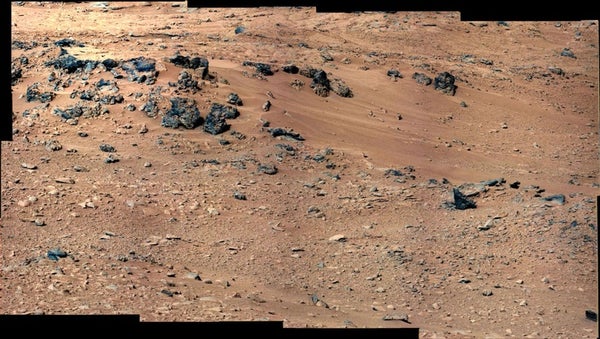
NASA’s Curiosity rover has an unwanted film lining its mouth. But instead of swishing around some water or mouthwash as a human might, the Mars-cruising robot plans to use a bit of Red Planet sand.
The rover, which landed on Mars in August, is approaching a patch of sand named Rocknest [to the right of the black rock outcrop in the photo above]. In a few weeks’ time mission managers plan to fire up Curiosity’s onboard chemistry labs to analyze soil samples from the area.
But first the rover must expunge the faint but lingering taste of its home planet. “By virtue of just being on Earth you get a residual oily film that is impossible to avoid,” Daniel Limonadi, the lead systems engineer for the rover’s surface sampling and science system at the NASA Jet Propulsion Laboratory in Pasadena, Calif., said during an October 4 teleconference with reporters.
On supporting science journalism
If you're enjoying this article, consider supporting our award-winning journalism by subscribing. By purchasing a subscription you are helping to ensure the future of impactful stories about the discoveries and ideas shaping our world today.
Limonadi later explained in an e-mail that the film is technically known as adventitious carbon. “It turns out we don’t really have a good handle of where this film comes from,” he wrote. “We just know that when surfaces are exposed to air environments on Earth they quickly accumulate this very thin film.”
To scrub away that film, he said in the teleconference, the rover will scoop up sand from Rocknest with its robotic arm, then use a vibration device to shake the sand around inside the sample-collecting hardware at a “tooth-rattling” 8 g’s. “We take the sand sample, this fine-grained material on this dune ripple, and we effectively use it to rinse our mouth three times and then spit out,” Limonadi said.
After the completion of the sand cleanse, which is expected to take a week or more, Curiosity will be ready to transfer samples from its scoop to the SAM (Sample Analysis at Mars) and CheMin (Chemistry and Mineralogy) instruments to analyze the chemical composition of the sand.
—John Matson