
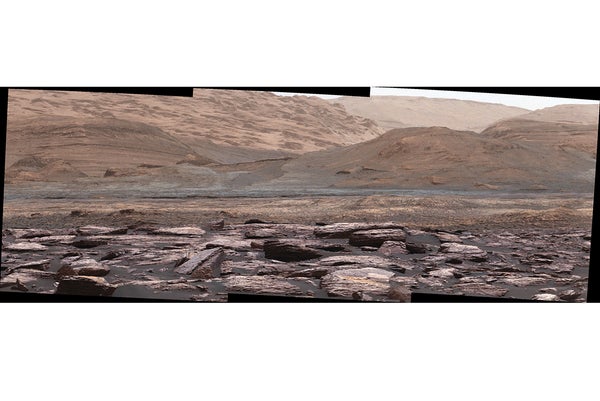
Mars may appear red when viewed from Earth, but NASA's Curiosity rover has captured an up-close photo of the planet's mountainous landscape, with purple-colored rocks littered across the foreground.
This remarkable new photo was captured near the base of Mars' Mount Sharp. The image's three frames were taken by Curiosity's Mast Camera (Mastcam)on Nov. 10.
"Variations in color of the rocks hint at the diversity of their composition on lower Mount Sharp. The purple tone of the foreground rocks has been seen in other rocks where Curiosity's Chemical and Mineralogy (CheMin) instrument has detected hematite,” or a type of iron-oxide mineral, NASA officials said in a statement. "Winds and windblown sand in this part of Curiosity's traverse and in this season tend to keep rocks relatively free of dust, which otherwise can cloak rocks' color.” [Amazing Mars Photos by NASA's Curiosity Rover (Latest Images)]
On supporting science journalism
If you're enjoying this article, consider supporting our award-winning journalism by subscribing. By purchasing a subscription you are helping to ensure the future of impactful stories about the discoveries and ideas shaping our world today.
Mount Sharp rises 3 miles (5 kilometers) from the center of Mars' 96-mile-wide (154 km) Gale Crater. After arriving at the crater in 2012, Curiosity found evidence that suggested that the area could have supported microbial life in the ancient past.
In addition to the purple rocks in the foreground, the images from Curiosity capture higher layers of Mount Sharp. The rover will continue to traverse these slopes throughout the rest of its mission.
This uphill trek began in October at the orange-colored rocks of the Murray formation, near the base of Mount Sharp. Next the rover will climb upward to the Hematite Unit, followed by the Clay Unit and the rounded hills of the Sulfate Unit — which is Curiosity's highest planned destination . Studying the composition of these different rock layers can help scientists learn more about Mars' past.
The images have a white-balanced color adjustment that resembles how rocks and sand would appear under daytime lighting conditions on Earth. This helps geologists who study the rocks recognize color patterns that they are familiar with on Earth, NASA officials said in the statement.
Copyright 2016 SPACE.com, a Purch company. All rights reserved. This material may not be published, broadcast, rewritten or redistributed.