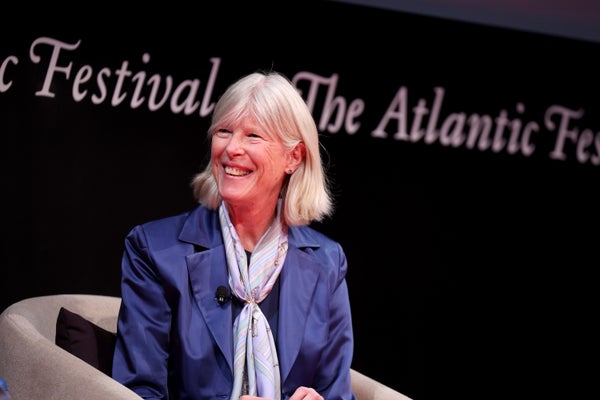
Cynthia Kenyon is vice president of aging research at Calico Labs. She is an emeritus professor at the University of California, San Francisco, where her lab’s discovery of genes that affect the aging process in a small roundworm called Caenorhabditis elegans helped spawned a groundswell of research around the molecular determinants of aging.
[This interview was edited for length and clarity.]
How would you describe the current state of American science?
On supporting science journalism
If you're enjoying this article, consider supporting our award-winning journalism by subscribing. By purchasing a subscription you are helping to ensure the future of impactful stories about the discoveries and ideas shaping our world today.
You know, sometimes the news is horrible; sometimes the news is not so horrible. I think the consensus is that science is really, really, really good for America, but I don't think we have a consensus on the state of American science. All the curiosity-based investigations that led to incredible breakthroughs in medicine and technology are just amazing. And I think it takes a long investment.
People have to feel safe and kind of happy and able to just freely explore the world, you know, because that’s where the really big new breakthroughs came from. Even AI, which is changing everything right now, started out as an academic exercise, an exercise in curiosity.
We did, for a long time, have a big consensus starting after World War II and the creation of National Institutes of Health and other science-funding bodies. The thought was the government should fund science, and people should be left to explore. It’s so important for the country, and it would be just good to get everybody onboard with that concept again.
For example, the work we did with aging, our tiny roundworms—they’re just as big as a comma in a sentence—showed that you could change the rate of aging, and it sort of started a revolution that’s created a whole industry now, with many well-funded companies now trying to increase not just human lifespan but health span. But there are many examples in all fields. It’s so good for the country, and conversely, it’s bad for the country to take it away.
What needs to change in American science?
I did my postdoc in England at the medical research center where the structure of DNA [had been] figured out in the 1950s. I was there in the 1980s, and Stephen Jay Gould gave a talk. He talked about the shape of beaks and all these cool stories about evolution. One thing he said, though, at the end of his talk, was that in America, people in Kansas were wondering whether to teach evolution in schools, and people in England were absolutely horrified. That was a long time ago, and it’s gotten even worse. I think we need education systems, starting with elementary school and high school, that teach reasoning and learning and, you know, the ability to question hypothesis generating and testing, so people learn how to think logically and critically. We’re doing it less now. It’s like termites in a house. We’re sort of chewing away at the foundation here a little bit by lessening the standards that we have in elementary schools and high schools so that we’re not at the top anymore.
What gives you optimism right now?
Well, I am very optimistic that science will be just fine because scientists are like birds. They go to safe places where there’s lots of food, and they’re going to be safe places in the world that they can go to, and they're doing it. So I am not worried about science. Science will be just fine. What I’m worried about is science in America. We have something that is unique in the world and unbelievably valued, treasured and coveted by other countries. And what gives me optimism is: there’s always a pendulum, and that pendulum swings wildly one way or the other, and it always seems to swing back. People understand the truth, and the truth is science is good. It’s good for our quality of life. And because it’s good, people will support it. And that gives me optimism.
What’s your best advice for an early-career scientist?
Learn how to be a good scientist, first and foremost. Read articles; be skeptical of what you read. Do experiments; do controls; talk to other scientists. Go to meetings, and do whatever it takes to do that. Go to the best labs and do the best science and take joy in the pleasure of doing science and in your ability to be in a situation that allows you to do science. Then pay close attention to where the opportunities are going to be for you. Watch where science funding is; watch where the jobs are. And finally, talk about why science is good for the country.