
Leonardo da Vinci
by Walter Isaacson.
Simon & Schuster, 2017 ($35)
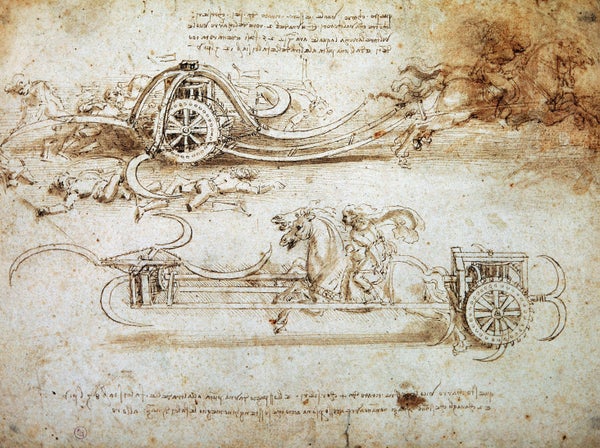
He created the Mona Lisa and The Last Supper and sketched the legendary Vitruvian Man. Yet his tremendous paintings are only part of the story. As historian and writer Isaacson painstakingly chronicles, Leonardo da Vinci was an obsessive learner and thinker who conducted extensive research on human anatomy, the mechanics of flight, optics and mirrors, to name a few. Unlike other Renaissance men of his time, he insisted on discovering things for himself rather than relying on the past work of others. In this way, he set the stage for the scientific method, demanding of himself meticulous observation, experimental procedure and reproducibility of results. Above all, this biography shows that his curiosity drove him in all things—to understand the nuances of the world, from the workings of the smallest feathered creature to the way light enters the human eye.
Spineless: The Science of Jellyfish and the Art of Growing a Backbone
by Juli Berwald.
Riverhead Books, 2017 ($27)
On supporting science journalism
If you're enjoying this article, consider supporting our award-winning journalism by subscribing. By purchasing a subscription you are helping to ensure the future of impactful stories about the discoveries and ideas shaping our world today.
After ocean biologist Berwald completed her Ph.D., she landed a job that left her unsatisfied—writing school textbooks on physics, far from the salty waters she loved. Working later as a journalist, she happened on a set of jellyfish photographs and was struck by these unique and mysterious animals. They captivated Berwald, so she decided to use her journalistic skills to dig deeper into their biology. In this memoir/science-reporting mash-up, she profiles one of the ocean's most intriguing creatures—theunique contractions it uses to propel through water, its acidifying habitat and its booming populations. Most of all, Berwald gets back to the ocean science she loves. —Leslie Nemo
The River of Consciousness
by Oliver Sacks.
Knopf, 2017 ($27)
This bricolage of posthumously published essays by polymath physician and author Sacks forms a brilliant whole, showcasing his lifelong fascinations with evolution, perception, memory, creativity and time. In one exemplary sequence, an essay about Darwinian botany and the locomotion of plants segues seamlessly into another exploring the neurological limits to the speed of thought, which leads into a third speculating about the mental lives of worms, insects and jellyfish—and beyond. By the end, the interconnected ideas and insights flow together like braided streams from Sacks's deep pools of knowledge, forming a final retrospective of one of our age's greatest scientific storytellers. —Lee Billings
Whitewash: The Story of a Weed Killer, Cancer, and the Corruption of Science
by Carey Gillam.
Island Press, 2017 ($30)
In the 1970s droves of farmers around the world bought the expensive weed killer Roundup. They laid it on heavy, too, applying 101 million pounds of glyphosate—the active ingredient—to soybeans during a 10-year span in the U.S. alone. Unlike other pest agents such as DDT, this chemical was touted as environmentally sound by its producer, Monsanto. But claims began to surface that glyphosate was a carcinogen that persisted in crops and food products. By digging through court documents, FOIA request findings and laboratory results, science writer Gillam traces the rise of the ubiquitous chemical and the controversy that erupted when farmers, researchers and concerned citizens started questioning what Monsanto was selling. —L.N.