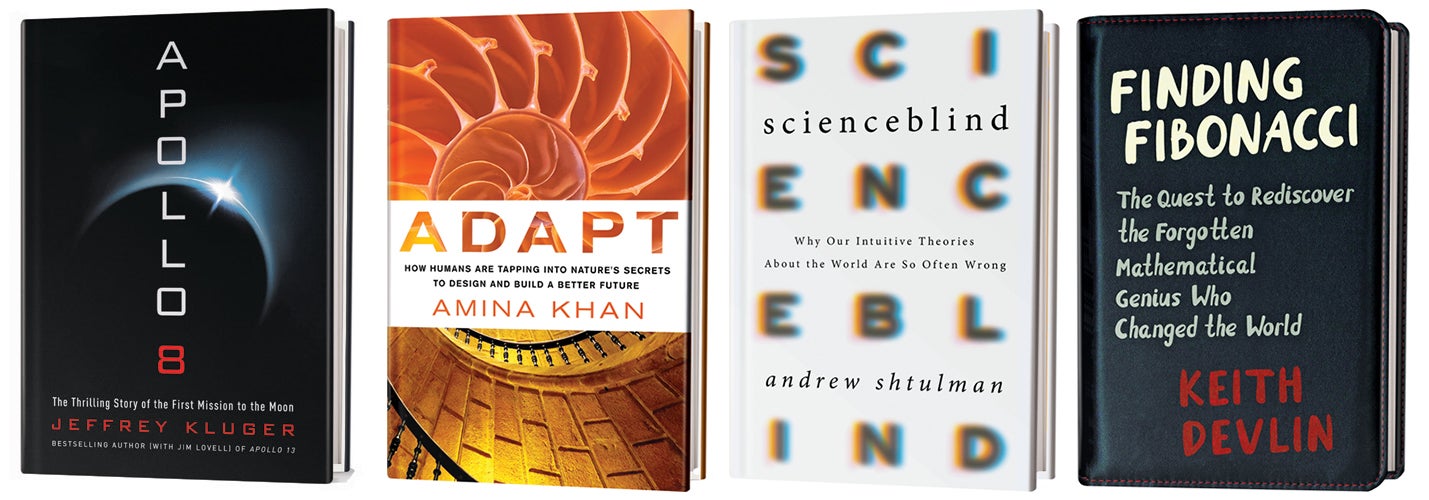
Apollo 8: The Thrilling Story of the First Mission to the Moon
by Jeffrey Kluger.
Henry Holt, 2017 ($30)
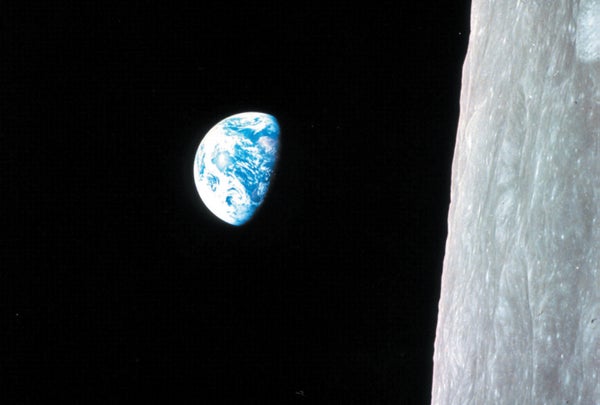
In the summer of 1969 Neil Armstrong and Buzz Aldrin took humanity's first steps onto the lunar surface during nasa's Apollo 11 mission. Yet an arguably more epochal event occurred the previous year, when the crew of Apollo 8—astronauts Frank Borman, Jim Lovell and Bill Anders—embarked on the first voyage to lunar orbit. Their flight was also the first time that human beings escaped Earth's gravity and, with its live television broadcast from around the moon, the first time that billions of people on Earth witnessed their home planet from a cosmic perspective. Kluger, a science journalist, previously co-authored the best-selling book turned blockbuster film Apollo 13, and his latest foray into space history overflows with similarly cinematic details. Apollo 8 delivers the definitive story of what is, and always will be, one of humanity's greatest adventures. —Lee Billings
Adapt: How Humans Are Tapping into Nature's Secrets to Design and Build a Better Future
by Amina Khan.
St. Martin's Press: 2017 ($26.99)
On supporting science journalism
If you're enjoying this article, consider supporting our award-winning journalism by subscribing. By purchasing a subscription you are helping to ensure the future of impactful stories about the discoveries and ideas shaping our world today.
Imagine military combat gear that automatically changes color to match its surroundings, from desert to snowy tundra. This is one of the goals of researchers looking to the natural world to improve on human design and innovation. For the combat gear, scientists are studying the pigments in cuttlefish that change to blend in with the fish's background. Science writer Khan walks readers through other examples: Snakes and the physics of slithering, which might help engineers design new probes; and termites, whose towering mud nests could inspire next-generation architecture. Biomimicry, as the design philosophy is known, could generate some $1 trillion in goods and services globally and help to solve environmental and health problems, Kahn reports. But to make it work, we must first understand the wondrous evolutionary adaptations of the natural world.
Scienceblind: Why Our Intuitive Theories about the World Are So Often Wrong
by Andrew Shtulman.
Basic Books: 2017 ($30)
It is nothing new that some people are distrustful of science. Shtulman, a professor of cognitive science and psychology, points out that this skepticism arises from many sources: political and religious beliefs, cultural identity, as well as our own intuitive, inborn theories. Such theories help even babies intuit basic concepts of matter and motion. But they also lead us down incorrect lines of reasoning—the earth is flat because we can't see the ground curve around us, for instance. Shtulman shows how the intuitive theories of the physical and biological world can blind us to science. Consider the innate theory that a bullet shot from a gun will hit the ground later than a bullet simultaneously dropped straight down. Repeated physics experiments show they hit at the same time, one of many examples of, as the author calls it, the triumph of evidence over intuition.
Finding Fibonacci: The Quest to Rediscover the Forgotten Mathematical Genius Who Changed the World
by Keith Devlin.
Princeton University Press: 2017 ($29.95)
Mathematicians developed the familiar 10-digit numerical system, known as the Hindu-Arabic numerals, over the course of centuries. One man, however, helped to bring that system to the West. His name was Leonardo of Pisa, although we know him better as Fibonacci. Leonardo's 1202 Book of Calculation popularized the Hindu-Arabic numerals by teaching Italian merchants to do arithmetic without the abacus. Devlin's account is as much about his own quest to reveal the mathematician's legacy as it is about Leonardo himself. The author, a Stanford University mathematician, talks his way into Italian research libraries in search of early manuscripts, photographs all 11 street signs on Via Leonardo Fibonacci in Florence and strives to cultivate a love for numbers in his readers. —Andrea Marks