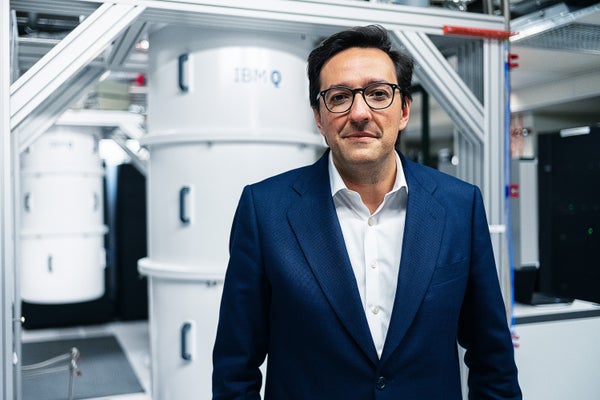
Darío Gil is an engineer and technology executive serving as the U.S. Department of Energy’s undersecretary for science and innovation. Previously, he led IBM Research as senior vice president and director, overseeing research in artificial intelligence, quantum computing, semiconductors and related technologies.
[This interview was edited for length and clarity.]
How would you describe the current state of American science?
On supporting science journalism
If you're enjoying this article, consider supporting our award-winning journalism by subscribing. By purchasing a subscription you are helping to ensure the future of impactful stories about the discoveries and ideas shaping our world today.
American science is at an inflection point. We are in the midst of a computing revolution that is certain to transform the practice of science and engineering in our country and across the globe. AI and quantum computing offer a fundamentally new paradigm for understanding the natural world. They are the new scientific instruments of our time, and just as telescopes and microscopes transformed how we see the very large, the very far and the very small, AI and quantum supercomputers are going to transform how we make sense of the very complex. By designing systems that can learn, adapt, reason and experiment, not just calculate, we are creating the engines that will drive discoveries for the next century of American innovation.
What needs to change in American science?
We have the most vibrant and successful science and technology ecosystem in the world. And as a nation, we invest $1 trillion annually in R&D. While federal investments provide the irreplaceable and indispensable foundation of this ecosystem, it is crucial that we recognize that two thirds of R&D investments are carried out by the private sector. Universities and philanthropic research institutions constitute the other pillars that sustain the American innovation ecosystem. This is a period in which we require institutional innovation to leverage the full strengths of an ecosystem that is a national treasure. National efforts like the Genesis Mission point us in the right direction.
What gives you optimism right now?
The opportunity to accelerate scientific breakthroughs. Consider AlphaFold, built on decades of foundational work, including the Protein Data Bank, which was established, in part, at Brookhaven National Laboratory in 1971. Over 50 years, the global scientific community determined roughly 200,000 protein structures through painstaking experimental work. Using that dataset, modern AI systems expanded that number to more than 200 million structures in just a few years.
This is not incremental progress. It is a step change. And it is already reshaping entire fields, from biology to medicine. It shows what becomes possible when long-term scientific investment meets new computational paradigms.
What’s your best advice for an early-career scientist?
My biggest advice is to ignore all the AI luminaries and prognosticators predicting the obsolescence of your expertise and the end of our professions. Deep domain expertise remains essential—it is what gives direction, meaning and rigor to even the most powerful tools. The pace of change is real, and it can create uncertainty. But this is also a moment of extraordinary possibility. Lean into this moment and run toward solving hard problems. We are not about to run out of them any time soon.
How has your field changed in the past few years?
The pace of change has been astonishing, even for those of us working at the frontier of computing. For decades, high-performance computing (HPC) was defined by large-scale simulations that could take days, weeks or even months to run. Today AI-driven surrogate models—trained on those validated simulations—can deliver results in a fraction of the time, fundamentally expanding what is possible on top of HPC.
At the same time, we are seeing the emergence of autonomous scientific workflows, systems that can generate hypotheses, design experiments, execute them and analyze results in closed loops. These capabilities are already being demonstrated across the Department of Energy’s national laboratories, alongside increasingly sophisticated robotic laboratories.
And in quantum computing, we are just a few years away from realizing the first generation of fault-tolerant quantum computers with hundreds of logical qubits, marking the transition to systems capable of addressing scientifically meaningful problems.
Taken together, these shifts are not isolated advances. They represent a systemic transformation. The ground is shifting under the entire scientific enterprise.