
Our galaxy took shape more than 13 billion years ago, when clouds of cosmic dust collapsed from their own gravitational pull, and the resulting heat and pressure slowly transformed them into stars and planets ... or something like that. Details of the Milky Way’s origin story are still fuzzy, and studying this ancient process is exceptionally tricky.
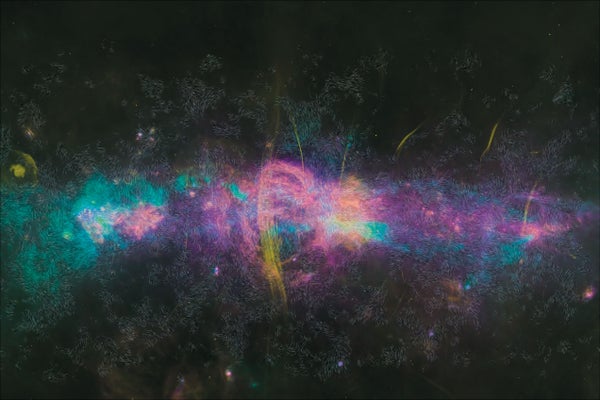
But a new map of the galactic center and its magnetic field offers scientists an unprecedentedly detailed look into the forces that powered our galaxy’s emergence. Researchers around the world spent four years gathering and combining telescope data that show how interstellar dust across 500 light-years of the Milky Way’s center interacts with the galaxy’s magnetic field.* The resulting map is the first to depict the field with such clarity at this resolution, says the project’s principal investigator, Villanova University physicist David T. Chuss.
Chuss and his team studied space dust using the Stratospheric Observatory for Infrared Astronomy, a NASA telescope that tracked infrared light while mounted in an aircraft flown at 45,000 feet. Magnetic fields cause light waves emitted by dust to orient in particular ways, giving that light a property called polarization—so measuring the polarization can reveal nearby magnetism. Villanova physicist Dylan Paré and his colleagues converted the telescope’s data into segments suitable for visual representation, and Kaitlyn Karpovich, then an undergraduate student, crafted the colorful background using additional telescopes’ data on dust temperature and dispersion.
On supporting science journalism
If you're enjoying this article, consider supporting our award-winning journalism by subscribing. By purchasing a subscription you are helping to ensure the future of impactful stories about the discoveries and ideas shaping our world today.
The colors symbolize different particle temperatures: blue and purple indicate cold and warm dust, respectively, and yellow denotes hot gas. The small, swirling gray lines represent the magnetic field. “I’m still pretty astounded at how complex the field is,” Chuss says. “I stare at this map a lot but am still always noticing new things about it.”
Astronomer Roberta Paladini of the California Institute of Technology says studying Milky Way dust can illuminate the elaborate interplay between gravity and magnetism, helping scientists investigate when and why dust clouds collapse to form stars. “When we have these two forces working in balance, the cloud doesn’t collapse,” she says. “But at some point gravity always wins—and examining magnetic fields will help us know when collapse actually happens and stars emerge.”
*Editor’s Note (7/8/24): This sentence was edited after posting to correct the description of dust across 500 light-year’s of the galaxy’s center.