
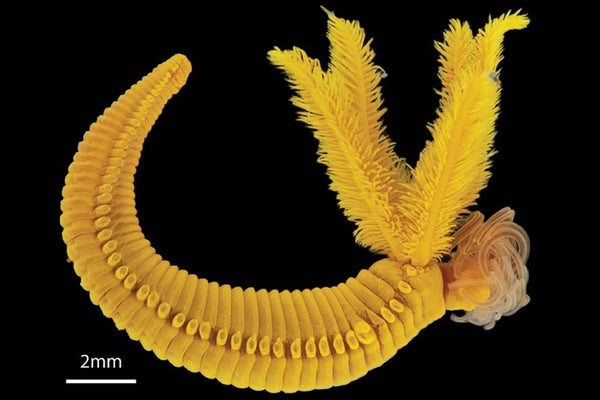
A bright-yellow worm that lives in deep-sea hydrothermal vents is the first known animal to create orpiment, a brilliant but toxic mineral used by artists from antiquity until the nineteenth century. The findings were published in PLoS Biology this week.
The worm (Paralvinella hessleri) is the only creature to inhabit the hottest part of deep-sea hydrothermal vents in the Okinawa Trough in the western Pacific Ocean. The hot, mineral-rich water that shoots up from the sea floor contains high levels of toxic sulfide and arsenic.
Researchers found that the worm accumulates microscopic particles of arsenic on its outer skin cells as well as along its internal organs. This reacts with sulfide from the hydrothermal vent to form small clumps of orpiment, fashioning a microscopic armour around the worm that protects it from the toxic environment.
On supporting science journalism
If you're enjoying this article, consider supporting our award-winning journalism by subscribing. By purchasing a subscription you are helping to ensure the future of impactful stories about the discoveries and ideas shaping our world today.
Orpiment is a naturally occurring arsenic sulfide mineral, often found in hydrothermal and magmatic ore deposits.
The findings came as a surprise to the research group. In the deep sea, creatures dwell in total darkness and are typically grey-ish white or adorned in hues of orange to dark red, says co-author Hao Wang, a deep-sea biologist at the Chinese Academy of Sciences in Qingdao. It “doesn’t make any sense to make pigment in total darkness,” Wang says.
Unknown mechanism
The team is yet to discover how arsenic is transported into the creature’s internal organs.
Other deep-sea creatures are known to produce minerals as a protective armour. The scaly-foot snail (Chrysomallon squamiferum) for instance, hosts bacteria that detoxifies sulfide through the extracellular biomineralization of iron sulfides in its scales, says Narissa Bax, a marine scientist at Greenland Institute of Natural Resources in Nuuk.
“Paralvinella hessleri may intentionally combine toxins into a single, ‘safe’, crystalline mineral within its own cells,” she says. It’s ability to fight poison with poison in this way is remarkable, she adds.
But further research to confirm how this occurs will be challenging, owing to the extreme conditions in deep-sea vents, and difficulties studying such species outside their natural environments, she says. Cultivation of P. hessleri in a laboratory setting is currently not possible.
This article is reproduced with permission and was first published on August 28, 2025.