
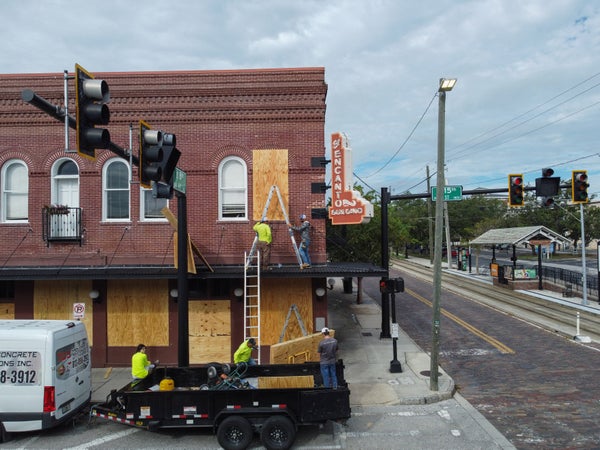
CLIMATEWIRE | As Hurricane Milton churns toward Tampa Bay, scientists say the swiftly intensifying storm could bring historic devastation to Florida’s second-largest metropolitan area.
It’s a nightmare scenario that has long haunted Florida officials.
For years, scientists and urban planners have warned that rising sea levels and worsening tropical cyclones have made storms a bigger threat to the coastal Tampa Bay area, which includes the cities of Tampa, Clearwater and St. Petersburg. And they have strongly suggested that the low-lying region invest in stronger adaptation efforts and more resilient infrastructure to protect itself.
On supporting science journalism
If you're enjoying this article, consider supporting our award-winning journalism by subscribing. By purchasing a subscription you are helping to ensure the future of impactful stories about the discoveries and ideas shaping our world today.
“We are all aware of the risk of the ‘big one’ — a catastrophic major hurricane making landfall,” said Brian Auld, chair of the regional business coalition Tampa Bay Partnership, in a foreword to a 2022 report making an economic case for greater climate adaptation and resilience efforts in the Tampa region.
Now, two years later, it seems those warnings have come too late. While the region has made some improvements to address the threat of a major hurricane, the projects still fall short of what experts say is needed.
Hurricane Milton is projected to become the first major hurricane to make direct landfall in Tampa Bay in more than a century. It’s the strongest storm on record to form in the Gulf of Mexico so late in the season, according to University of Colorado hurricane expert Philip Klotzbach, reaching Category 5 strength with wind speeds exceeding 175 mph.
And it’s one of the fastest intensifying storms on record. Milton gained more than 90 mph in wind speeds over the course of just 24 hours, according to Ken Graham, director of the National Weather Service.
“That’s the third highest that we have on record behind Wilma and Felix,” he said at a press briefing Monday. “This is one of the strongest storms we’ve had in the Atlantic basin since Dorian [in 2019]. This is not a good situation — this is a serious, serious situation.”
The storm weakened overnight to a Category 4 hurricane. It is forecast to make landfall Wednesday evening as a Category 3 storm.
It’s not just Milton’s strength that makes the situation so dangerous. Tampa Bay’s unique geography and the background influence of rapidly rising sea levels makes the region vulnerable to extreme impacts from much lesser storms.
Sea levels along parts of the Gulf Coast are rising as much as three times faster than the global average, studies have found. And a 2019 report from the Tampa Bay Climate Science Advisory Panel, a consortium of local scientists, warned that the region may be facing anywhere from one to 2.5 feet of sea-level rise by the year 2050. Rising sea levels put coastal areas at increasing risk of storm surge and coastal flooding.
At the same time, Tampa Bay’s topography — with its shallow coastline and low-lying communities — make it especially susceptible to the impacts of storm surge.
Those risks became apparent just two weeks ago, when Hurricane Helene caused record-breaking storm surge in Tampa Bay, despite making landfall more than 100 miles north in Florida’s Big Bend region. Preliminary tide gauge readings suggest some communities saw water levels above 7 feet, in some cases more than 2 feet higher than their previous peaks.
Now, scientists say Milton could blow those records away. The National Hurricane Center warns that Milton could cause storm surge of 10 to 15 feet in Tampa Bay. Experts already project the storm could cause tens of billions of dollars in damages.
Though shocking, none of this comes as a surprise to experts.
A 2013 report from the World Bank placed Tampa seventh on a list of the top 10 global cities facing the costliest damage from coastal floods. And a 2015 report from the Boston catastrophe risk assessment firm Karen Clark & Co. placed Tampa first on a list of U.S. cities most vulnerable to storm surge flooding. The study projected losses of $175 billion in the event of a catastrophic hurricane.
Some communities have begun taking measures to protect themselves.
City Council members in the town of St. Petersburg recently approved a $1.6 million construction project to rebuild deteriorating seawalls in the Riviera Bay neighborhood, although the project comes too late for Hurricane Milton. The city also recently updated its Stormwater Master Plan, recommending around $1 billion in projects designed to improve water quality and mitigate flooding through the year 2050.
The nearby town of Clearwater is investing $100 million on flood mitigation projects in its North Beach neighborhood.
The city of Tampa, meanwhile, has a number of flood mitigation projects underway in neighborhoods around the city. The city also was recently awarded a $24.7 million federal grant for improvements to its Palmetto Beach neighborhood, including stormwater and flood mitigation projects.
Emergency mitigation projects also have shown potential for success during recent extreme weather events. Tampa General Hospital successfully protected itself from flooding during Hurricane Helene by installing a temporary floodwall built by Norwegian manufacturer AquaFence.
Still, city officials have recognized that Tampa needs more long-term investment in climate resilience. The city released a 156-page climate adaptation and equity plan last year, outlining recommendations for its transition to a low-carbon, climate-resilient economy. It noted that Tampa is vulnerable to coastal flooding, storm surge and hurricanes.
While "Tampa avoided the worst impacts of Hurricane Ian, the storm is a painful recent reminder that our neighborhoods are vulnerable to severe storms that are increasing in frequency,” the report stated.
Meanwhile, other local reports from Tampa Bay communities have warned the region must invest more resources in climate adaptation and resilience to shield itself from floods and storms.
The Tampa Bay Partnership’s 2022 report — making an economic case for climate resilience — called for a variety of flood-related adaptation measures including seawalls and other coastal barriers, beach nourishment and elevated, flood-proof buildings. While these adaptations are costly in the short term, the report estimated significant economic benefits in the long run.
Though the report warned of a worst-case scenario hurricane, it also noted that flood risks are already severe in the case of lesser storms and rainfall events.
“While there is often talk of the big storm — the catastrophic major hurricane — the frequent flooding analyzed in this report can have major economic consequences for the region,” the report stated. “There is a compelling case to make for Tampa Bay to invest in resilience right now.”
Reprinted from E&E News with permission from POLITICO, LLC. Copyright 2024. E&E News provides essential news for energy and environment professionals.