
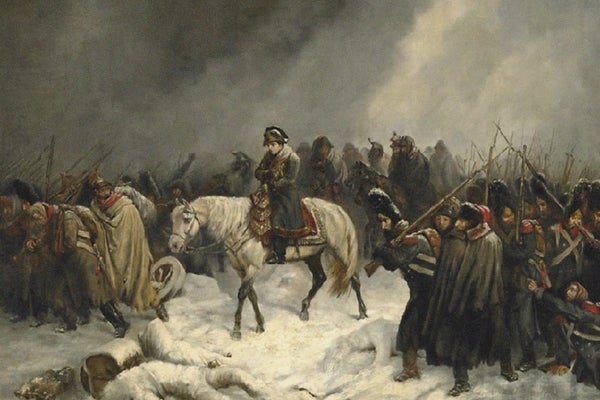
Beginning on June 24, 1812, around 600,000 soldiers led by French emperor Napoleon Bonaparte crossed the Neman River to invade the Russian Empire. The war was one of the most costly in history, and just under six months later, only a few tens of thousands of men returned across the river.
The massive losses have historically been attributed to soldiers falling in battle, succumbing to frostbite, starving to death or dying in a typhus epidemic. But now a new, not-yet-peer-reviewed preprint study by microbiologist Rémi Barbieri of Paris City University and his team have identified other pathogens that might actually have been responsible for much of the death.
Historical records from the time show that doctors that accompanied the army diagnosed typhus from symptoms such as fever, headaches and skin rashes, and an analysis of remains in a 2006 study had suggested possible infections with typhus and trench fever. But when Barbieri and his team examined the preserved teeth of 13 of Napoleon’s fallen soldiers, they were unable to find any evidence of Rickettsia prowazekii, the bacterium responsible for epidemic typhus, or Bartonella quintana, the cause of trench fever, which infected more than a million soldiers during World War I.
On supporting science journalism
If you're enjoying this article, consider supporting our award-winning journalism by subscribing. By purchasing a subscription you are helping to ensure the future of impactful stories about the discoveries and ideas shaping our world today.
Instead they found traces of the bacterium Salmonella enterica—which causes typhoid fever, not to be confused with typhus—and Borrelia recurrentis, which causes relapsing fever and is mainly transmitted by body lice.
With the help of modern medicine, typhoid and relapsing fever both have very high survival rates. But these previously unidentified pathogens could have easily caused death in soldiers who had already been weakened from cold and hunger and were living in terrible hygienic conditions.
The researchers note that their sample of 13 soldiers is too small to be sure that other diseases, such as typhus, did not kill many other soldiers during Napoleon’s retreat. They only have not yet found evidence of such infections.
Napoleon himself survived the retreat almost unscathed. The losses brought his rule over Europe to a slow end, however. In 1815 Napoleon was finally defeated by the U.K. and Prussia at the Battle of Waterloo.
This article originally appeared in Spektrum der Wissenschaft and was reproduced with permission.