
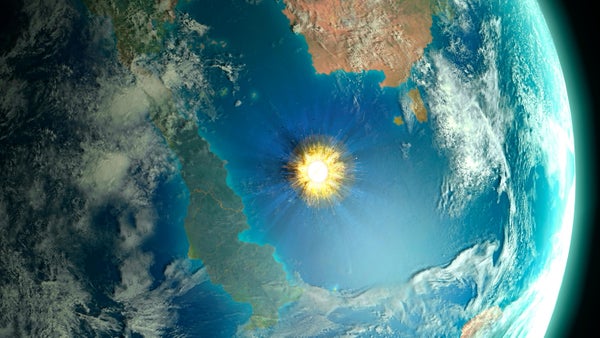
Dust might have been responsible for the deadly dinosaur-killing global winter that came after an asteroid slammed into Earth 66 million years ago, finds a study published on 30 October in Nature Geoscience.
A team of geoscientists led by Cem Berk Senel at the Royal Observatory of Belgium in Brussels reinvestigated the aftermath of the impact that formed Mexico’s Chicxulub crater — a collision that wiped out the non-avian dinosaurs and much of life on Earth.
The researchers looked at a well-preserved sample of rock formed at the time of extinction event in what is now North Dakota. Such rocks contain traces that geoscientists use to mark the change from the Cretaceous period to the Palaeogene period in Earth’s history. They looked at the amounts of sulfur, soot and minerals called silicates in the sample, and found that the sample contained many more small, fine particles of silicate dust — ranging from about 0.8 to 8.0 micrometres in diameter — than expected.
On supporting science journalism
If you're enjoying this article, consider supporting our award-winning journalism by subscribing. By purchasing a subscription you are helping to ensure the future of impactful stories about the discoveries and ideas shaping our world today.
Senel’s team thinks that the asteroid impact threw up clouds of these tiny particles that blocked out the Sun and could have prevented plants from photosynthesizing for up to two years after the impact. As a consequence, vegetation would have died off, resulting in the starvation of many herbivorous species, including some dinosaurs. This could have helped to kick off a catastrophic mass-extinction event.
The dust might have stayed in the atmosphere for up to 15 years, the team’s models suggest. During this time, global temperatures would have dropped by as much as 15 °C.
“We need to gain deeper knowledge of what caused the global cooling or the loss of photosynthesis in order to advance our understanding of the exact killing mechanisms that followed the Chicxulub impact,” says Senel. “This is the first time that paleoclimate simulations have pointed to a 2-year suppression of photosynthetic activity and 15–20 years of dust-induced impact winter.”
This article is reproduced with permission and was first published on October 30, 2023.