
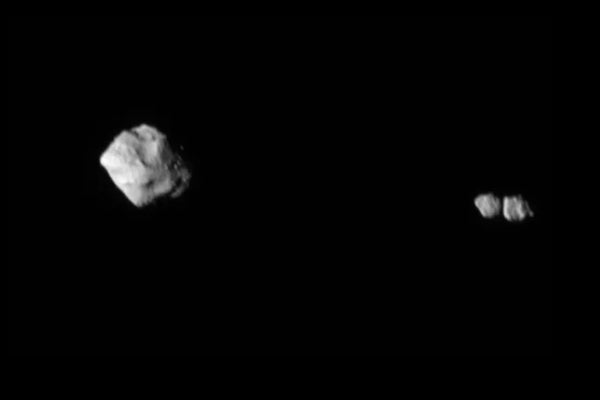
Asteroid Dinkinesh continues to surprise us.
On Nov. 1, NASA's Lucy spacecraft zoomed past this space rock, marking the first of several asteroid encounters the probe is designed to make. Lucy's goal is to ultimately explore a set of asteroids near Jupiter, known as the Trojans, which are thought to hold clues about the earliest days of our solar system; these objects may be able to shed light on the origins of life on Earth. But, on the way to those Trojans, Lucy has a couple of stops — including Dinkinesh, which sits in the main asteroid belt between Mars and Jupiter.
On Nov. 2, project scientists with the Lucy mission announced the first flyby came with a surprise: Dinkinesh, or 'Dinky,' appears to be not one asteroid, but two. Lucy was able to observe that Dinkinesh is a binary system, meaning there is a small natural satellite in orbit around it.
On supporting science journalism
If you're enjoying this article, consider supporting our award-winning journalism by subscribing. By purchasing a subscription you are helping to ensure the future of impactful stories about the discoveries and ideas shaping our world today.
And today (Nov. 7), scientists announced another surprise.
In a NASA statement, the Lucy team writes that Dinky's smaller satellite is itself a type of binary system known as a "contact binary," meaning the two smaller objects are in contact with one another. This means Dinky isn't made up of one, or two, but rather three components.
"It is puzzling, to say the least," the Southwest Research Institute's Hal Levison, principal investigator for Lucy, said in the statement. "I would have never expected a system that looks like this. In particular, I don't understand why the two components of the satellite have similar sizes. This is going to be fun for the scientific community to figure out."
Lucy spotted the third rock in this asteroid system six minutes after snapping the images that initially revealed Dinkinesh wasn't alone. In that time, the probe had traveled 960 miles (1,545 km) from the point at which it discovered the first satellite.
Contact binary systems seem to be fairly common throughout our solar system, but scientists hadn't seen one orbiting another asteroid prior to Dinkinesh, Lucy's deputy project scientist John Spencer said in the statement. "We'd been puzzling over odd variations in Dinkinesh's brightness that we saw on approach, which gave us a hint that Dinkinesh might have a moon of some sort, but we never suspected anything so bizarre!"
Again, however, Dinkinesh and its two satellites are only the first of many asteroids Lucy will visit during its planned 12-year mission that began in Oct. 2021, when it launched from Kennedy Space Center atop a United Launch Alliance (ULA) Atlas V rocket.
After leaving Dinky, the probe will head back to Earth for a gravity assist maneuver in December 2024. This assist is expected to slingshot the probe back out to the main asteroid belt, where it will study the asteroid Donaldjohanson in 2025.
From there, Lucy will move on to its main goal: The Trojan asteroids.
The spacecraft will become the first mission to visit these early solar system relics, and if all goes according to plan, Lucy will visit eight different Trojan asteroids between 2027 and 2033. Possibly, the spacecraft will uncover more space rock surprises along the way.
"It's truly marvelous when nature surprises us with a new puzzle," Tom Statler, Lucy program scientist from NASA Headquarters in Washington, said in the statement. "Great science pushes us to ask questions that we never knew we needed to ask."
Copyright 2023 Space.com, a Future company. All rights reserved. This material may not be published, broadcast, rewritten or redistributed.