
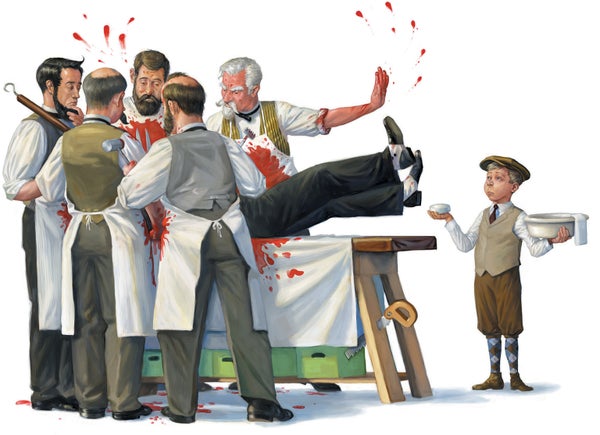
On July 2, 1881, Charles Guiteau shot President James Garfield in the back. On September 19, 1881, Garfield died, with a bullet still lodged in fatty tissue behind his pancreas. At his trial, Guiteau denied killing the president. “Garfield died from malpractice,” the gunman said. His point was made incredibly moot when he was executed by hanging. But he'd made a decent argument.
Historian David Oshinsky discusses Garfield's medical care in his fascinating new book Bellevue: Three Centuries of Medicine and Mayhem at America's Most Storied Hospital: “Had the responding physicians ... done nothing more than make Garfield comfortable,” Oshinsky writes, “he almost certainly would have survived. Instead they searched clumsily for the bullet, inserting unwashed fingers and filthy probes into the open wound.”
Two days after the shooting, experts, including Frank Hamilton, a surgeon in his late 60s from Bellevue, examined the president, “without pausing to wash their hands or clean their instruments,” Oshinsky notes. Hamilton's age was a factor, with the old guard less receptive to newfangled ideas about handwashing and instrument cleaning.
On supporting science journalism
If you're enjoying this article, consider supporting our award-winning journalism by subscribing. By purchasing a subscription you are helping to ensure the future of impactful stories about the discoveries and ideas shaping our world today.
As fellow Bellevue veteran Alfred Loomis put it at the time, according to Oshinsky, “The [germ] theory, which so recently has occupied medical men, especially in Germany, is rapidly being disproved, and consequently is rapidly being abandoned.” Loomis, respected enough to also serve as president of the New York Academy of Medicine, mockingly told an audience of his fellow physicians, “People say there are bacteria in the air, but I cannot see them.”
Of course, bacteria don't care if you believe in them. Infections caused Garfield to lose almost 100 pounds between the shooting and his death, and his autopsy showed that a good part of what was left of him was pus. Adding insult to literal injury, Hamilton sent Congress a bill for what we'll call his services in the sum of $25,000—equivalent to about $600,000 today. Congress approved a $5,000 payment, which is still about $120,000 in modern money for not washing your hands.
The Garfield section of Oshinsky's book (as much a history of New York City and of American medicine as it is of Bellevue) made me think of the subject considered in this space last month. That write-up dealt with the revolution in the statistical analysis of baseball. But the larger issue was, if I may quote myself, “information availability and decision making in baseball as a microcosm of the larger problem that a wide array of human enterprises face: insisting on remaining stupid when becoming smarter is an option.”
Which, speaking of Congress, brings us to the House of Representatives Committee on Science, Space, and Technology. On December 1 the committee's Twitter account announced that global temperatures were in fact plummeting and that what they called “climate alarmists” had clammed up (perhaps in their rapidly acidifying ocean habitat).
The committee's source for this welcome info was Breitbart News. If you were lucky enough to spend the 2016 presidential election campaign in a medically induced coma, Breitbart regularly produces the other stuff that comes out of a cow's backside besides the greenhouse gas methane.
The committee chair, Representative Lamar Smith of Texas, has harassed legitimate climate scientists and does not buy global climate change. He easily could buy it, given that the fossil-fuel industry has given him more than $600,000. That's not just dirty money—it's full of soot.
According to Oshinsky, Loomis finally accepted germ theory when Robert Koch showed that the tuberculosis bacterium was indeed visible, if you used a microscope. Climate change is also obvious if you use worldwide surveillance, including that recorded by NASA satellites. But as I write these words, the new presidential administration is planning to do away with NASA's Earth observation mission because—why?—it's become political. (Don't think about that reasoning too much, or the smoke coming from your ears will further contribute to the greenhouse effect.)
This move is like Loomis gouging his eyes out rather than seeing through the microscope. And we insist on staying stupid when becoming smarter is an option.