
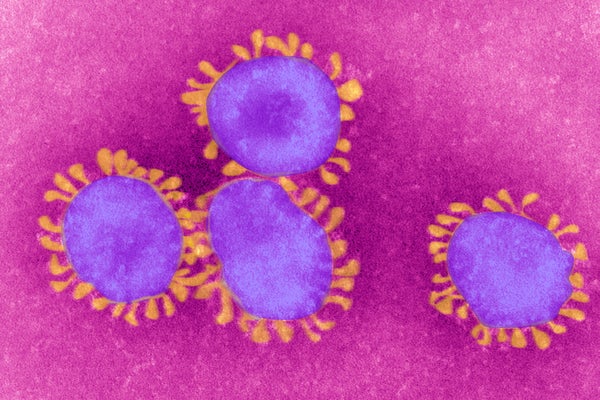
The disease caused by the novel coronavirus has a name: COVID-19.
Tedros Adhanom Ghebreyesus, the director-general of the World Health Organization, announced the name Tuesday, giving a specific identifier to a disease that has been confirmed in more than 42,000 people and caused more than 1,000 deaths in China. There have been fewer than 400 cases in 24 other countries, with one death.
In choosing the name, WHO advisers focused simply on the type of virus that causes the disease. Co and Vi come from coronavirus, Tedros explained, with D meaning disease and 19 standing for 2019, the year the first cases were seen.
On supporting science journalism
If you're enjoying this article, consider supporting our award-winning journalism by subscribing. By purchasing a subscription you are helping to ensure the future of impactful stories about the discoveries and ideas shaping our world today.
The virus that causes the disease has been known provisionally as 2019-nCoV. Also on Tuesday, a coronavirus group from the International Committee on Taxonomy of Viruses, which is responsible for naming new viruses, proposed designating the novel coronavirus as SARS-CoV-2, according to a preprint of a paper posted online. (Preprints are versions of papers that have not yet been peer-reviewed or published in a scientific journal.) The name reflects the genetic similarities between the new coronavirus and the coronavirus that caused the SARS outbreak of 2002-2003.
In selecting COVID-19 as the name of the disease, the WHO name-givers steered clear of linking the outbreak to China or the city of Wuhan, where the illness was first identified. Although origin sites have been used in the past to identify new viruses, such a namesake is now seen as denigrating. Some experts have come to regret naming the infection caused by a different coronavirus the Middle East respiratory syndrome.
“Having a name matters to prevent the use of other names that can be inaccurate or stigmatizing,” Tedros said. “It also gives us a standard format to use for any future coronavirus outbreaks.”
Viruses and the disease they cause do not have to have related names—think HIV and AIDS—but more recently those responsible for the formal naming process have kept them associated. For example, SARS, the disease, is caused by SARS-CoV, the virus.
The provisional name of the new virus stemmed from the year it was first seen (2019), the fact that it was new (n), and a member of the coronavirus family (CoV).
A clear name could also stop the ad hoc identifiers that have sprung up in the press and online, many of which, like the Wuhan virus or Wu Flu, linked the virus to the city.
Republished with permission from STAT. This article originally appeared on February 11 2020