New Issue: Orbital Catastrophe Ahead? Read Now

Dmitrii Kochkov

Making artificial-intelligence tools to predict what climate change will mean for extreme weather

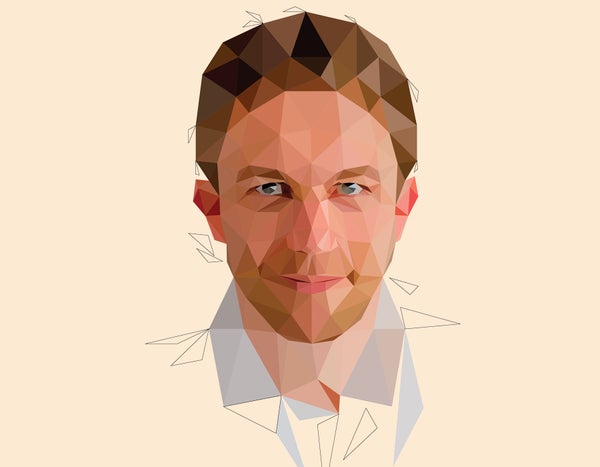
Stylized illustration portrait of Dmitrii Kochkov by Jessine Hein.

Jessine Hein; With special thanks to the Exploratorium, San Francisco, Calif.

Join Our Community of Science Lovers!

As a child in Petrozavodsk, Russia, Dmitrii Kochkov loved solving geometry puzzles with his parents. In high school he participated in math and physics competitions. By the time he reached graduate school, he had turned toward machine learning and quantum physics to solve tough problems. The now 34-year-old joined Google Research as an AI resident in 2019, using machine learning to create programs that could solve interesting equations. His career then turned toward weather and climate change.

Weather is governed by fluid dynamics, described in part through partial differential equations. These equations underpin the computer models that meteorologists use to forecast daily and weekly weather. The model then applies global weather data to tell us whether we should expect rain, sunshine or extreme heat. But some processes, such as cloud formation, must be approximated in the models, which can lead to errors and biases. Kochkov and his teammates built NeuralGCM (for “general circulation model”) to replace those approximations with machine-learning predictions trained on past weather data. The system can predict weather conditions on par with the best models (up to 15 days out) and reproduce past temperature patterns as accurately or more so than current gold-standard models.


On supporting science journalism

If you're enjoying this article, consider supporting our award-winning journalism by subscribing. By purchasing a subscription you are helping to ensure the future of impactful stories about the discoveries and ideas shaping our world today.


Portrait photograph of Dmitrii Kochkov by Christie Hemm Klok.

Christie Hemm Klok

NeuralGCM is starting to show results. Researchers at the University of Chicago have used it to forecast the start of monsoon rains in India up to one month in advance, providing crucial information to millions of farmers. Kochkov’s team is creating a newer version of the model that is easier to use, which will eventually allow scientists to study how climate change is altering weather extremes and water availability. This comes at a time when funding for this kind of research is unstable. “Enabling people to do the best work they can with given resources seems more important than ever before,” he says.

This article is part of The Young American Scientists, an editorially independent project that was produced with financial support from Regeneron. Special thanks to the Exploratorium in San Francisco, where Kochkov's portrait and video interview were captured.

Andrea Thompson is senior editor for Earth and environment at Scientific American, covering the environment, energy and Earth sciences. She has been covering these topics for nearly two decades. Prior to joining Scientific American, she was a senior writer covering climate science at Climate Central and a reporter and editor at Live Science, where she primarily covered earth science and the environment. She has moderated panels, including as part of the United Nations Sustainable Development Media Zone, and appeared in radio and television interviews on major networks. She holds a graduate degree in science, health and environmental reporting from New York University, as well as a B.S. and an M.S. in atmospheric chemistry from the Georgia Institute of Technology. Follow Thompson on Bluesky @andreatweather.bsky.social

More by Andrea Thompson
Scientific American Magazine Vol 335 Issue 1This article was published with the title “Dmitrii Kochkov” in Scientific American Magazine Vol. 335 No. 1 (), p. 51
doi:10.1038/scientificamerican072026-1qskwvNTHlsypkTEddEceB

Subscribe to Support Independent Journalism

Great science journalism requires human expertise, time, effort and creativity. And it costs money. That’s why I and the journalists here at Scientific American hope you’ll join our community.

When you subscribe, you are supporting staff and freelance journalists who are passionate about telling science stories that are true, important and compelling. Our editors and reporters are often experts in their fields, which means they understand the nuances of big discoveries and can untangle the breakthroughs from the hype. With a subscription, you are also supporting rigorous fact-checking to ensure the words we publish are precise and accurate. And you’re supporting original illustrations, graphics and photos that bring you closer to an advanced laboratory, an ice sheet in Antarctica or a space mission in orbit. You’re helping us craft other types of high-quality journalism as well: Our newsletters are carefully written, edited and curated by staffers you have or will come to know and love. Our Science Quickly podcast is based on original reporting, collaboration with editors and scientists and exacting production.

Subscriptions keep this engine running so we can continue to deliver thoughtful, rigorous and independent science journalism to you. In an era of viral misinformation, this work is crucial. If you value what we do, I hope you’ll consider joining us as a subscriber

Thank you,

Jeanna Bryner, Editor in Chief, Scientific American

Subscribe