
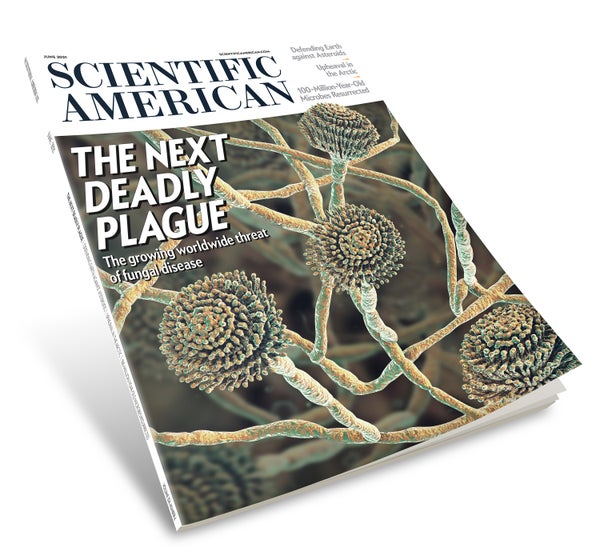
What do you think of this month's cover image? We had a bit of a debate about it here at Scientific American's virtual HQ. The illustration is based on scanning electron microscope images of Aspergillus fumigatus, a ubiquitous fungus that can infect the lungs. The intricate, other-worldly structures look really cool. But some people might reasonably think they're also kind of gross. After all, we recoil from a moldy piece of fruit or the smell of mildew, and as author Maryn McKenna reports, fungal infections are a terrifying health menace.
We decided the cool-to-gross ratio justified using the image, and we hope it intrigues you. The discussion got me thinking about how people who appreciate science—including our readers and I'd say all of us on the magazine staff—might have a higher tolerance for images or ideas that others find unsettling. The universe isn't just expanding, but it's expanding at a faster rate all the time? Tell us more! The human body contains more microbial cells than human cells? Fascinating. Beady-eyed, buzzy cicadas spend 17 years in a hole in the ground and then emerge by the billions? Show us their life stages and how they do it because that's amazing.
If you're in Brood X territory this summer, I hope you enjoy the cicada eruption as much as the bug-eating birds will. Senior editor Kate Wong and illustrator Cherie Sinnen present the bizarre life history of 17- and 13-year cicadas. Multiple species coordinate their hatches to overwhelm predators and produce a glut of offspring that will spend most of their lives underground before they emerge for a few weeks of liberation and screeching and desperate mating.
Many of us can relate while emerging into public spaces, jittery and blinking, after 17 months of a dark and isolating pandemic.
The most fascinating (to me) but potentially disturbing (to some people, understandably) experience I've had is observing a brain surgery, which I had the privilege of doing while I was a graduate student studying cognitive neuroscience. The patient had an arteriovenous malformation, a tangle of blood vessels that increases the risk of stroke. Before the surgeons removed it, they gently stimulated surrounding parts of the brain while the patient—who was awake—responded to questions that let them map the cortex and avoid resecting any parts involved in language. Neuroscientist and Scientific American advisory board member Christof Koch explains how such research has revealed the locations of surprising sensations throughout the brain.
Some bacteria, like cicadas, can also play the long game, as science writer Jennifer Frazer describes here. While plesiosaurs drifted overhead 100 million years ago, cells settled to the bottom of the sea. When researchers pulled the microbes up in a seabed core and fed them, they woke up and started reproducing.
Svalbard is home to a global seed vault with more than a million samples, a worst-case-scenario backup plan for preserving biodiversity. It's also the Arctic location of the world's fastest-warming town. Journalist Gloria Dickie takes us there and exposes the environmental, economic and social changes in a place where citizens of any of 46 countries are welcome to live.
Communities around the world are engaging in what amount to natural experiments in how to organize their economies and social contracts. Environmentalist and author Ashish Kothari discusses some of the principles of sustainability that have allowed these societies to flourish.
This year or possibly next, NASA is planning to launch a mission called DART—the Double Asteroid Redirection Test—that will be the first trial of a “kinetic impactor” strategy to deflect an asteroid. As science writer Sarah Scoles warns, it's just a matter of time before a very big asteroid threatens to slam into Earth. The sooner we can see it coming, the better chance we'll have of knocking it off course. Edgard Rivera-Valentín, a scientist who worked at the asteroid-observing Arecibo telescope before it collapsed recently, says, “Dinosaurs didn't have a space program. But we do.”