
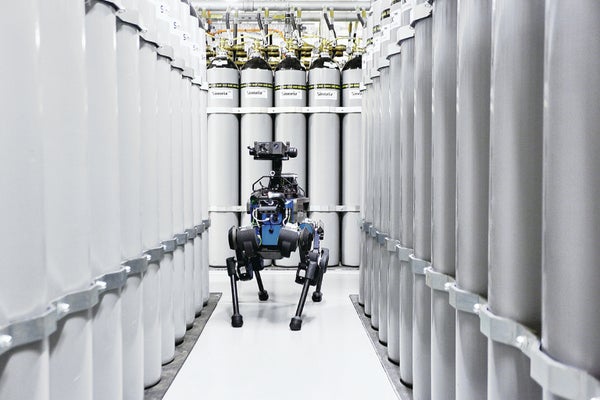
Programming robots that can walk, run and grasp is laborious, so researchers would prefer that they learn on their own. To solve the problem of wear-and-tear on real robots learning by trial-and-error, groups of researchers are developing ways to simulate the bots and download the skills they learn to real hardware. A new method improves these simulations with data from the real robots, closing the feedback loop. The result is robots with boosted speed and agility.
Working with a robotic quadruped called ANYmal, roboticists at the Swiss Federal Institute of Technology Zurich (ETH Zurich) augmented its algorithms with neural networks (software inspired by the human brain). As the robot fumbles around in the real world, the neural networks learn the quirks of each of the bot’s motors. That information feeds back into the simulation, helping it more accurately model the real bot and thus produce more effective skills for downloading. In experiments, ANYmal broke its previous trotting speed record by 25 percent, the researchers reported in January in Science Robotics. It could also regain its balance after being pushed and its footing after being flipped.
ANYmal is commercially available through the ETH Zurich spinoff ANYbotics. Motors in its joints have tendonlike springs that absorb shock, store energy and provide sensory feedback. Each leg has three motors, all interchangeable. Jemin Hwangbo, a roboticist who helped to develop the simulation-based training method, says it was created for rescue operations and oil rig inspections. It can climb stairs and crawl through tunnels while carrying its heavy digital brain inside its dustproof and watertight body. A Kevlar belly helps it survive half-meter falls.
On supporting science journalism
If you're enjoying this article, consider supporting our award-winning journalism by subscribing. By purchasing a subscription you are helping to ensure the future of impactful stories about the discoveries and ideas shaping our world today.
Others are developing quadruped bots that rival ANYmal’s abilities. In 2008 Boston Dynamics gained notice for comical (and creepy) footage of its noisy, gas-powered “BigDog” trudging up treacherous terrain. The newer “SpotMini” is its 25-kilogram electric cousin. Sangbae Kim, a mechanical engineer at the Massachusetts Institute of Technology, who is not affiliated with Boston Dynamics, says SpotMini has the world’s most advanced algorithm for navigating around and over obstacles. The company plans to start selling it this year for jobs ranging from construction to home assistance. A top-mounted port allows users to attach tools, including a five-kilogram arm that can fetch drinks and load the dishwasher—truly a human’s best friend.
Kim’s team at M.I.T. has built a 40-kilogram bot named “Cheetah 3,” which he says moves more efficiently than four-legged animals of similar weight. The robot also has the most powerful joints of any legged robot of its size, he adds—they were built from scratch and produce as much torque as a car engine. The joints also regenerate energy and handle impacts well. Cheetah 3 is not as fast as its predecessor, Cheetah 2, which can run at 23 kilometers an hour, Kim says. But it can perform backflips (at least in theory) as well as climb stairs and obstacles without relying on camera vision. It is built for research, however, so do not expect to adopt one soon.