
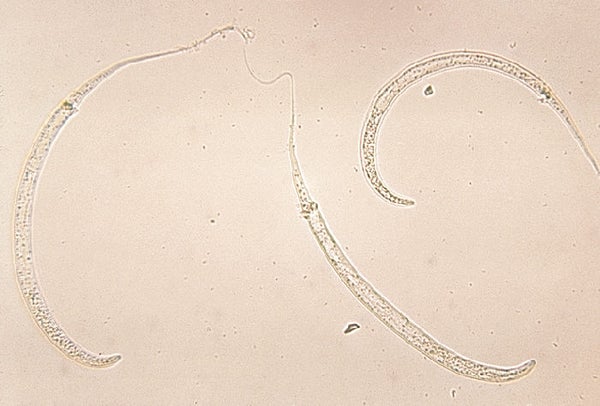
A decades-long push to make Guinea-worm disease the first parasitic infection to be wiped out is close to victory. But a mysterious epidemic of the parasite in dogs threatens to foil the eradication effort.
“If we’re going to be aggressive and achieve this, we have to eliminate the infection in dogs,” says David Molyneaux, a parasitologist at Liverpool School of Tropical Medicine, UK.
The Carter Center in Atlanta, Georgia, is leading the global campaign to eradicate Guinea worm. Next week, it will announce that case numbers for the excruciatingly painful infection are at a record low, with approximately 25 cases reported in 2015 in just 4 countries: Chad, Ethiopia, Mali and South Sudan. But infections in dogs are soaring in Chad, where officials will meet at the end of January to grapple with the canine epidemic. The central African nation recorded more than 450 cases of Guinea worm in domestic dogs last year—an all-time high (see ‘Canine comeback’).
On supporting science journalism
If you're enjoying this article, consider supporting our award-winning journalism by subscribing. By purchasing a subscription you are helping to ensure the future of impactful stories about the discoveries and ideas shaping our world today.
Researchers and officials strongly suspect that dogs are spreading the infection to humans; now the race is on to understand how this might happen, as well as how dogs acquire the infection in the first place. The World Health Organization is unlikely to declare Guinea worm eradicated until the parasite has stopped spreading in dogs, says Molyneaux, who is part of the commission that will make that decision.
In 1986, when the Carter Centre joined the Guinea-worm eradication campaign, there were an estimated 3.5 million infections annually, mostly due to poor sanitation and lack of access to clean water.
When people drink unfiltered water, they can swallow microscopic freshwater crustaceans called copepods, which Guinea-worm larvae infect. The copepods die, releasing the larvae, which mature and mate in the human intestine. Male worms die after mating, but adult females—approximately 80 centimetres in length—survive and slowly migrate out of the gut. About a year after infection, they burrow through their host’s skin, usually around the legs and feet, sometimes taking weeks to fully escape. To cope with the searing pain, many people bathe in rivers and lakes, contaminating the water with the next generation of larvae. Although rarely fatal, Guinea worm can debilitate people for months and keep children out of school.
There is no vaccine against the parasite and no effective treatment, so eradication efforts have focused on providing clean water and changing people’s behaviour, says Donald Hopkins, a special adviser at the Carter Center who is leading its Guinea-worm eradication efforts. People in areas in which the parasite was once rife have learnt to filter their water using cloths and to avoid re-contaminating water supplies. Even the most out-of-the-way villages now quickly contain cases and report them to health officials.
Chad was on the cusp of being declared free of Guinea worm in the late 2000s: no case had been recorded in the previous decade. But starting in April 2010, increased surveillance turned up a handful of human infections, and around 60 cases have been recorded since then.
The cases are unusually sporadic and isolated from one another, says Mark Eberhard, a parasitologist who consults on Guinea-worm eradication for the Carter Center. More typically, cases occur in clusters and recur in the same village year after year. “There was no increase or explosion of cases as one would expect,” he says.
Shortly after these observations, officials began to hear rumours of Guinea-worm-infected dogs in Chad. Researchers have known for decades that dogs, leopards and other mammals occasionally acquire Guinea-worm-like infections, but they assumed that these cases stemmed from distinct species of Dracunculus, the nematode worm that causes the disease, or were rare examples of infections that had somehow spilt over from an outbreak in humans.
But in Chad, researchers now think that dogs are spreading the worms to humans—not the other way around. Between January and October 2015, officials recorded 459 canine infections from 150 villages in the central African nation—an unprecedented volume. And genome sequencing has confirmed that dogs in Chad are infected by the same nematode worms (Dracunculus medinensis) that plague humans (M. L. Eberhard et al. Am. J. Trop. Med. Hyg. 90, 61–70; 2014).
To better understand the situation, a team led by James Cotton and Caroline Durrant, genome scientists at the Wellcome Trust Sanger Institute in Hinxton, UK, is now sequencing the genomes of more Guinea worms collected from dogs and humans in Chad to confirm that dogs are indeed transmitting the disease to people. And Eberhard, who is convinced that this is the case, is trying to determine how dogs become infected in the first place. They are unlikely to contract the worms from drinking water, he says, because dogs tend to scare away copepods when they lap. Most of Chad’s cases have occurred among fishing communities along the Chari River, and Eberhard suspects that dogs are eating the entrails of gutted, copepod-eating fish. Dogs then pass the worms to humans by reintroducing the larvae into water.
Researchers, including Eberhard, are testing aspects of this hypothesis in ferrets, a common animal model in disease research, but eradication officials in Chad are not waiting for the results before taking action. Since February 2015, they have offered the equivalent of US$20 to people who report Guinea-worm cases in dogs and tie up the animals to prevent them from contaminating water sources. They are also encouraging villagers to bury fish entrails to keep dogs from eating them. And a trial is ongoing to test whether a drug used to treat heartworm—a roundworm parasite common in dogs—has any effect on Guinea worm. Because of Guinea worm’s one-year incubation time, it should be clear before the end of 2016 whether these interventions have worked.
Older residents from villages along the Chari River say that their fishing practices have not changed, according to Hopkins, and they cannot recall dogs becoming infected with Guinea worm in the past. But Molyneaux says that the dearth of humans transmitting the disease could explain the parasite’s jump to dogs. “If you were Guinea worm and there were only 100 of you left in the world,” he says, “what would you do? You’d get the hell out of the host that’s being targeted and move to something else.”
This article is reproduced with permission and was first published on January 5, 2016.