
It seems like every conversation these days quickly turns to COVID vaccines: Which of your dear ones have gotten a shot, when are you due for your booster, did you have any side effects? Social media is filling up with selfies of people showing off their “I got vaccinated” stickers in the post-vax observation rooms, bursting with a mix of joy and relief and gratitude that you can see in their eyes above their masks. (Another newly relevant pandemic word: “smizing,” or smiling in a way that's visible in your eyes.) Our Scientific American publisher, Jeremy Abbate, asked his mom if she felt any side effects from her second shot, and she said, “An acute appreciation for science.” He shared the exchange on Twitter, and about a quarter of a million people hit the heart-shaped “like” button. I'm sure I'm not the only one who would like to safely elbow-bump Jeremy's mom and every single scientist who worked on the vaccines, as well as everyone who produced, transported and delivered them, all the volunteers who are helping with outreach and recruitment, and everyone who has socially distanced and masked up and abided by the latest research and public health recommendations. Thanks to you, people are alive today who would have died.
Some of the people who have sacrificed the most during the pandemic are schoolkids and college students. Their COVID isolation has hit while they are developing social and emotional intelligence, finding a sense of purpose and understanding their place in the world. New research on the adolescent brain, shared by writer and Scientific American contributing editor Lydia Denworth, emphasizes that this is a time of opportunity for helping young people flourish, despite the challenges.
Our photo-essay may make you recall the smell of classroom chalk dust. Photographer Jessica Wynne has traveled the world (at least until COVID) to document mathematicians' blackboards, which, as space and physics editor Clara Moskowitz narrates, attempt to “reveal universal truth.
On supporting science journalism
If you're enjoying this article, consider supporting our award-winning journalism by subscribing. By purchasing a subscription you are helping to ensure the future of impactful stories about the discoveries and ideas shaping our world today.
The universe, by the way, is big. “Vastly, hugely, mind-bogglingly big,” as sci-fi humorist Douglas Adams wrote and astronomers Kyle Dawson and Will Percival have shown with their work on the largest map of the cosmos ever made, starting here. It's a three-dimensional map of four million galaxies over billions of light-years that may help solve the mysteries of dark energy and the shape of the universe (which is big).
For another mind bender, turn here to find out from researcher Kelly Jaakkola whether dolphins are left- or right-handed (even though they don't have hands) and why it's been so tricky for people to agree on which direction they're spinning.
Dolphins and about a quarter of all ocean species spend part of their lives near coral reefs, which are suffering. Marine scientists led by Raquel Peixoto are trying to find beneficial microbes that can help reefs withstand heat, disease and other pressures, and the work is now being tested in open waters. It's a risky strategy, but as science writer Elizabeth Svoboda explains, some experts say it's time to start taking risks.
The blood-brain barrier is basically a filter that lets sugar and oxygen in blood vessels into the brain but keeps proteins and pathogens out. Neuroscientists Daniela Kaufer and Alon Friedman have found that the barrier breaks down under various kinds of stress, and its leaks could be a sign or possibly a contributing cause of Alzheimer's disease and other pathologies. If so, reversing the damage could protect people from brain disorders.
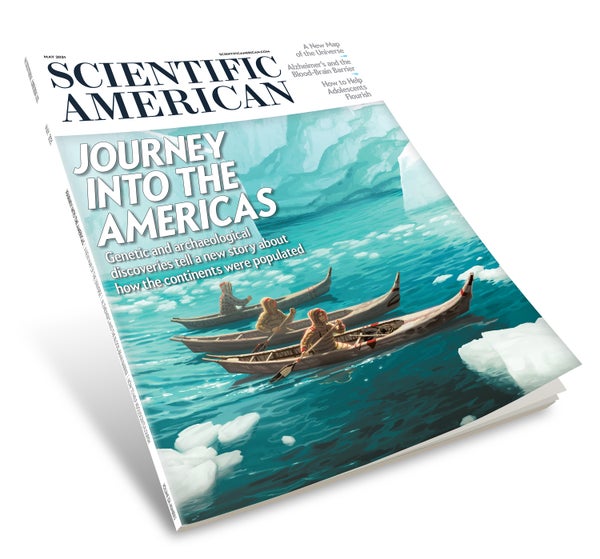
In our cover story, anthropological geneticist Jennifer Raff shares new discoveries about who the first people were to reach the Americas and how and when they arrived. (And do take a second look at the opening illustration of the aurora borealis.)