
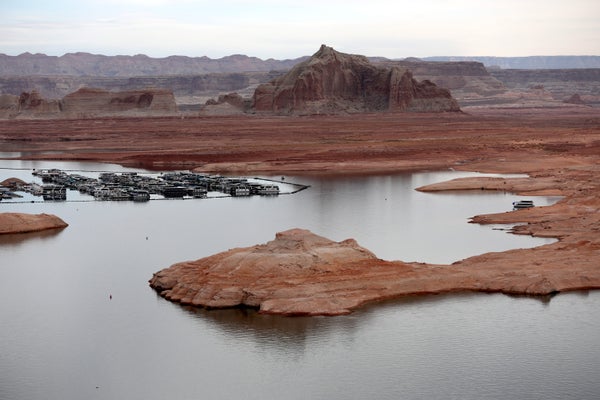
The precarious status of the Colorado River was brought into sharper focus today with the release of a federal study that determines how the basin’s big reservoirs will be operated in the coming year — and which states will be required to limit their water withdrawals from the shrinking river.
With key water supply reservoirs Mead and Powell near record low levels, Arizona, Nevada, and Mexico will shoulder the largest cuts from the Colorado River to date, forgoing a combined 721,000 acre-feet of water next year. The largest burden falls on Arizona, which will see its allocation reduced by 21 percent. Under the voluntary agreement signed in 2019 that governs the cuts, no other basin state is required to limit its withdrawals.
Federal officials have requested additional reductions in order to protect Mead and Powell, but the seven basin states did not meet a federal deadline to present a plan to conserve between two million and four million acre-feet of water next year. At the high end, that amount of conservation is nearly five times the cuts announced today and roughly equal to a third of the river’s recent annual flow.
On supporting science journalism
If you're enjoying this article, consider supporting our award-winning journalism by subscribing. By purchasing a subscription you are helping to ensure the future of impactful stories about the discoveries and ideas shaping our world today.
Camille Touton, commissioner of the Bureau of Reclamation, told the states in June that unless they acted the federal government would “protect the system” and apply its own remedy. The states missed that 60-day deadline and remain in fractious negotiations.
Without the additional cuts, Mead is projected to drop another 20 feet by July 2023 due to reduced releases from Powell, located upstream. Because Mead is V-shaped, it declines more rapidly at lower levels. Because Lake Powell is so low, only 7 million acre-feet will be released next year, which is not enough supply to meet typical demand.
Even as the basin states and Mexico continue to negotiate additional cuts, they will be implementing the reductions dictated by today’s study.
Each month Reclamation publishes a study that projects reservoir levels in the basin in each of the next 24 months. The August edition of that forecast is important for two reasons. It determines how much water will be released from Lake Powell to Lake Mead. It also determines the extent of water cuts in the lower basin states of Arizona, California, and Nevada, as well as Mexico.
The projections are based on a “most probable” scenario – flows into the reservoirs that would be exceeded half the time. Runoff in the basin, however, has trended in the opposite direction, registering consistently below average numbers for the last three years due to dry soils and high temperatures.
To account for this, Reclamation also runs a “probable minimum” scenario. It’s not worst case, but it’s close.
In that scenario, there are severe outcomes by the end of 2023. Lake Powell would be at 3,484 feet — six feet below the point at which hydropower generation stops. Lake Mead would be at 1,010 feet and on its way to an elevation below 1,000 feet by the summer of 2024. That would put it just 50 feet above dead pool, the elevation at which no water flows downstream.
These possible, daunting futures are why Commissioner Touton ordered the states to impose extra conservation and why the U.S. Congress included $4 billion in drought response funds in the Inflation Reduction Act, signed today by President Joe Biden.
The negotiations between states, however, have stalled amid accusations that proposals lack urgency and are short-sighted.
John Entsminger, general manager of the Southern Nevada Water Authority, which supplies Las Vegas, laid out his concerns in an August 15 letter to federal officials.
Entsminger accused special interests of “drought profiteering” by seeking inflated payments for reducing water use. He described a lack of “meaningful collective action to help forestall the looming crisis.”
He added: “Writing the next chapter will require each and every water manager to convince their elected officials and governing bodies that sacrificing something is the only way to save everything.”
This story originally appeared in Circle of Blue and is part of Covering Climate Now, a global journalism collaboration strengthening coverage of the climate story.