Drive Time: Curiosity Rover Ready to Roll toward First Martian Destination
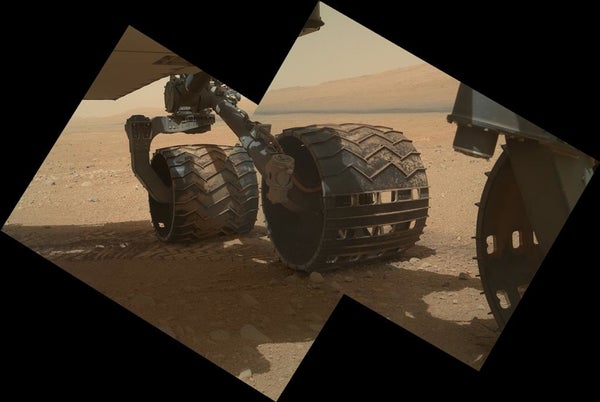
You can't take a spin on Mars without getting dirty. The photo mosaic above shows three of the six wheels on NASA's Curiosity rover, already dusted with Mars dirt after just a month on the Red Planet .
NASA/JPL-Caltech/Malin Space Science Systems
Join Our Community of Science Lovers!
You can't take a spin on Mars without getting dirty.
The photo mosaic above shows three of the six wheels on NASA's Curiosity rover, already dusted with Mars dirt after just a month on the Red Planet. Curiosity snapped the shots of its wheels and underbelly using the Mars Hand Lens Imager (MAHLI) on the end of the rover’s 2.1-meter robotic arm. MAHLI took the mosaic photos September 9, during a weeklong checkout of the robotic arm's functions.
The cutouts visible in Curiosity's wheels are used to estimate distance traveled by a process called visual odometry. (The cutouts also spell out "JPL" in Morse code in honor of the Jet Propulsion Laboratory in Pasadena, Calif., which manages the rover mission for NASA.)
On supporting science journalism
If you're enjoying this article, consider supporting our award-winning journalism by subscribing. By purchasing a subscription you are helping to ensure the future of impactful stories about the discoveries and ideas shaping our world today.
Having worked out its robotic arm, Curiosity will soon proceed toward its first destination, a region about 400 meters distant called Glenelg, where multiple terrain types meet. The rover's ultimate destination, the much more distant Mount Sharp, rises in the background on the right side of this MAHLI mosaic.
It’s Time to Stand Up for Science
If you enjoyed this article, I’d like to ask for your support. Scientific American has served as an advocate for science and industry for 180 years, and right now may be the most critical moment in that two-century history.
SciAm always educates and delights me, and inspires a sense of awe for our vast, beautiful universe. I hope it does that for you, too.
If you subscribe to Scientific American, you help ensure that our coverage is centered on meaningful research and discovery; that we have the resources to report on the decisions that threaten labs across the U.S.; and that we support both budding and working scientists at a time when the value of science itself too often goes unrecognized.