
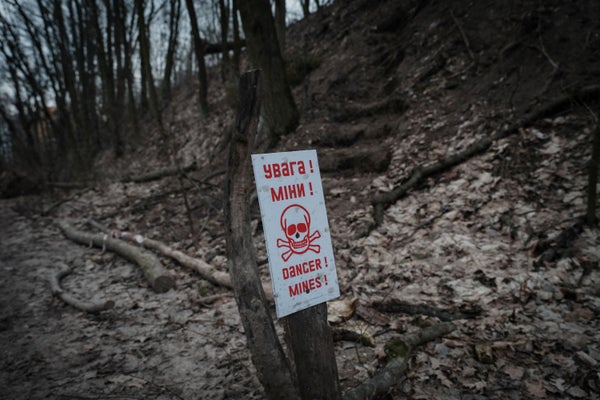
Finding and removing land mines is an excruciatingly slow process. Human deminers scour contaminated ground inch by inch with handheld metal detectors, waiting for the telltale beep of a magnetic anomaly. Although trained dogs are sometimes used, metal detectors have remained the go-to clearance method since the end of World War II.
“There's a very long period where there hasn't been much innovation in the field,” says Jasper Baur, a Ph.D. student in volcanology and remote sensing at Columbia University. Baur and his collaborators at Safe Pro Group, a manufacturer of personal protective gear, have been developing a drone-based machine-learning technology to make demining safer and faster than with traditional methods.
The idea is deceptively simple: A drone flies over an area thought to be mined, collecting a large volume of images. Baur's algorithm, trained on the visual characteristics of 70 types of land mines, cluster munitions, and other unexploded ordnance, processes the images into a map, with resolution down to a fraction of an inch. The model can then recognize and map explosives more quickly and accurately than a human reviewing the same images. “In a matter of minutes you'll have a map plotted out with where all the land-mine detections are,” Baur says.
On supporting science journalism
If you're enjoying this article, consider supporting our award-winning journalism by subscribing. By purchasing a subscription you are helping to ensure the future of impactful stories about the discoveries and ideas shaping our world today.
With a reported detection rate of about 90 percent, the drones are meant to augment traditional methods, not replace them. “It's less comprehensive because you're not going through inch by inch,” Baur says. But the approach can reveal potential dangers and can cover more ground than manual efforts.
Baur and his team have visited Ukraine to test the technology multiple times since the start of the war there. They hope their work can speed up a demining process that, using current resources, could take more than 750 years. By some estimates, Ukraine has about 67,000 square miles (an area roughly the size of Florida) that could harbor mines and other explosives. With the new system, “you can scan wide areas of land and try to figure out where the highest density of contamination is” before sending in humans to defuse the mines, Baur says.
For now the AI can detect only surface-level explosives, not deeply buried ones or those covered by vegetation. Baur's nonprofit organization, the Demining Research Community, is testing ways to look deeper by using thermal imaging and ground-penetrating radar. It is also developing a model that can rate the AI's level of confidence in its mine-detection results based on the amount of vegetation present.
Milan Bajić, an expert in remote sensing who has been involved in demining efforts in Croatia, says the approach is a valuable addition to the demining tool kit. “There is no silver bullet of technology,” he says, “but combining different technologies can be more successful than any of them.”