
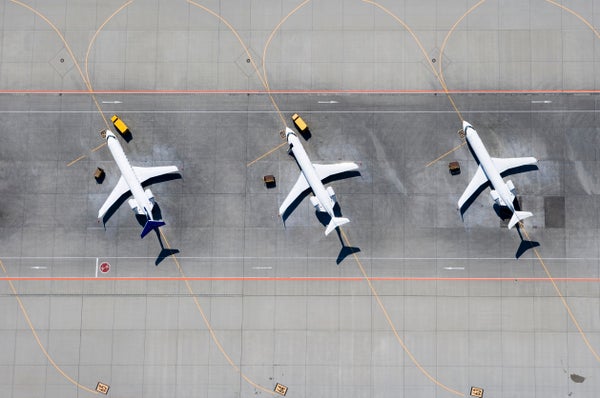
Months of pandemic-induced lockdowns have stymied international travel. And scientists say there could be an unexpected casualty: weather and climate forecasts.
In normal times, hundreds of thousands of planes and ships crisscross the planet daily, ferrying passengers or transporting cargo.
Many of these vessels are equipped with sensitive instruments that can collect a variety of scientific information about their surroundings—everything from air or ocean temperatures to wind speeds and humidity. Scientists often use the data to feed the models they use for weather forecasts and climate projections.
On supporting science journalism
If you're enjoying this article, consider supporting our award-winning journalism by subscribing. By purchasing a subscription you are helping to ensure the future of impactful stories about the discoveries and ideas shaping our world today.
But the slowdown in global travel has triggered concern among researchers, who are worried their forecasts may be suffering.
One new study, published last week in the journal Geophysical Research Letters, suggests the decline in global air travel has taken a toll.
The study evaluated the accuracy of global weather forecasts between March and May of this year—the height of the pandemic across much of the world. It then compared them with forecasts developed during the same months in 2017, 2018 and 2019, as well as with forecasts in February of this year, just before the pandemic hit.
The findings suggest that forecasts across much of the world became less accurate after the pandemic struck.
That’s a concern according to the study’s author, Ying Chen of Lancaster University in the United Kingdom.
It’s not just a matter of inconvenience if a forecast gets the weather wrong. Farmers, for instance, depend on accurate forecasts to protect their crops.
And utility companies estimate the amount of power that will be consumed in a given day using temperature forecasts. In a heat wave, demand for electricity tends to soar as people turn on their air conditioners.
If utilities are unable to accurately balance power generated versus power consumed, “this might impact the stability of the electric power grid,” Chen said.
The new study doesn’t prove that travel restrictions have caused the forecasts to deteriorate. But Chen makes the case that a decline in air traffic played a part.
For one thing, the difference in forecast accuracy was more pronounced in the Northern Hemisphere than in the Southern Hemisphere. Northern Hemisphere forecasts tend to rely more heavily on data collected by aircraft, Chen said.
Western Europe is a notable exception. European forecasts haven’t suffered as much as other parts of the Northern Hemisphere, the study suggests.
According to Chen, that may be because Europe has an impressive network of stationary weather observatories, which constantly collect the same types of data that scientists typically would get from airplanes.
There are lessons to be learned there, Chen noted. Improving the network of ground-based meteorological stations across the Northern Hemisphere may help lessen the impact of future global disasters affecting air travel.
And there are other ways to collect similar data in the meantime. Weather balloons, for instance, can help counter the absence of aircraft.
“That is also really helpful to compensate for the pandemic lacking data,” Chen said.
By land and by sea
It’s not just aircraft data that’s taken a hit.
A recent survey from the Global Ocean Observing System, a United Nations ocean monitoring initiative, suggests that a number of ocean-observing programs have suffered during the pandemic.
Data from the Ship of Opportunity Programme—an initiative that collects ocean measurements from commercial and other nonscientific vessels around the world—has decreased by about 90%, the report suggests. Meteorological data from a similar program, known as the Automated Shipboard Aerological Programme, has declined by 10%-15%.
The decline in ship-based observations isn’t catastrophic on its own. Scientists collect a great deal of ocean data from networks of buoys they’ve set up across the seas, rigged with instruments that continuously send information back to land.
But even these autonomous systems require updates and maintenance. And with fewer ships crossing the ocean, they may not be getting the attention they need.
The Argo network—one of the world’s largest and most important systems of autonomous ocean sensors—recently reported a 10% reduction in data, the Global Ocean Observing System report notes. It’s not clear yet how much pandemic-related disruptions are to blame. But it’s an issue to watch, the report suggests.
The Argo network relies on ships to deploy replacement buoys as needed and maintain the network. Typically, the network requires about 80 deployments each month to keep the network up to date, the report notes. But in May, only 10 deployments were possible.
If these conditions keep up—although it’s not clear yet that they will—the network could shrink by 10%-15% by the end of the year, the report warns.
These kinds of ocean observations not only inform short-term weather forecasts, but they are also used to keep tabs on long-term climate change.
Significant interruptions could potentially degrade marine weather forecasts—including the types that ships use to navigate through treacherous waters. And they also could cause gaps in long-term data sets that scientists use to monitor and study the effects of global warming.
For now, though, it’s not clear there have been any serious side effects.
While the report warns that continued interruptions could become a bigger problem for weather and climate forecasts, it also notes that global ocean observing systems so far have “shown resilience to the immediate impacts of pandemic-related shutdowns.”
That’s largely due to data still coming in from autonomous systems like Argo.
“The loss of data has been, in most cases, not so much that we’re seeing a degradation in any kind of broader analyses," David Legler, director of the Ocean Observing and Monitoring Division at NOAA, said in an interview with E&E News.
There are some specific areas of research, however, that may suffer some interruptions, he added. Scientists studying the exchange of carbon dioxide between the ocean and the atmosphere rely heavily on observations taken from research ships.
“So there is likely to be a gap in our records in large parts of the ocean by not being able to make those measurements over long periods of time," he said. “The implications of that is to be determined."
For the most part, though, he said scientists are looking ahead to make plans that would support their research and adhere to public health recommendations.
“In NOAA, we’re working very hard and very creatively with our partners to try to maximize our opportunities to utilize ships and to keep going on the missions that are very important to us," he said. “But we’re also prioritizing the safety of our employees and partners.”
Reprinted from Climatewire with permission from E&E News. E&E provides daily coverage of essential energy and environmental news at www.eenews.net.