
On supporting science journalism
If you're enjoying this article, consider supporting our award-winning journalism by subscribing. By purchasing a subscription you are helping to ensure the future of impactful stories about the discoveries and ideas shaping our world today.
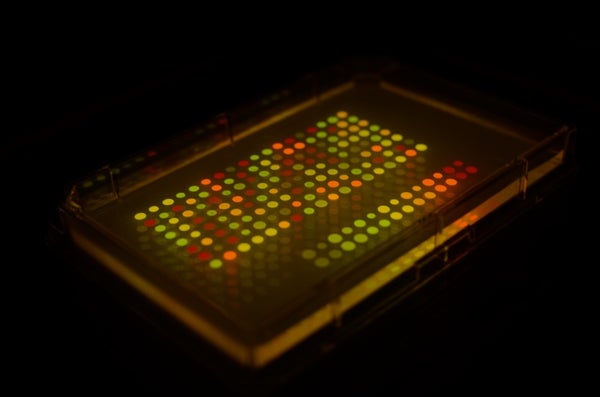
Spread across an agar plate, these 144 bacterial colonies spell out a secret message: "this is a bioencoded message from the walt lab at tufts university 2011." The plate is described in a paper published online September 26 in Proceedings of the National Academy of Sciences, in which Tufts University researchers demonstrated for the first time that living microorganisms can be used to transmit cryptic communications between people.
The experiment, called Steganography by Printed Arrays of Microbes, or SPAM, is the second proof-of-principle encryption venture to come out of chemist David Walt's lab. In 2009 the group created "infofuses"—metal-embedded flares that transmit messages in the infrared spectrum when burned. Other researchers have used bacterial genomes to hide messages, but reading those messages requires high-tech sequencing machinery.
"This is a lot easier to send and receive a message," Walt says. "To read it, all you really need is a handheld light."
To create the message shown, Walt transformed strains of Escherichia coli bacteria to express one of seven different fluorescent proteins. Then he devised a binary code in which two colors in a given sequence correspond to each letter of the alphabet, and plated the bacteria from left to right to spell out the message. (For example, the two colonies in the upper left corner of the plate are fluorescing in yellow, and two yellows in a row codes for the "t" in "this.") After the bacteria grew into colonies, they were large enough to transfer onto nitrocellulose paper (not shown here), which could be mailed to the recipient, who would then press the paper onto a clean agar plate and wait for the bacterial colonies to regrow in that medium. After about eight hours the message could be interpreted under a black light.
There are three levels of security built into the message: For one, the bacterial colonies are not visible on nitrocellulose paper, so a would-be interceptor would not know that the message is there. Next, the recipient would need to know the correct alphabetic code. Finally, because many of the colonies can spell a different message based on the type of plate, light or chemical used to read it, the interpreter would need to know those specifications as well.
Although the technique has no practical applications at this point, Walt hopes it may be useful to prevent the counterfeiting of currency or other valuable items.
--By Sarah Fecht